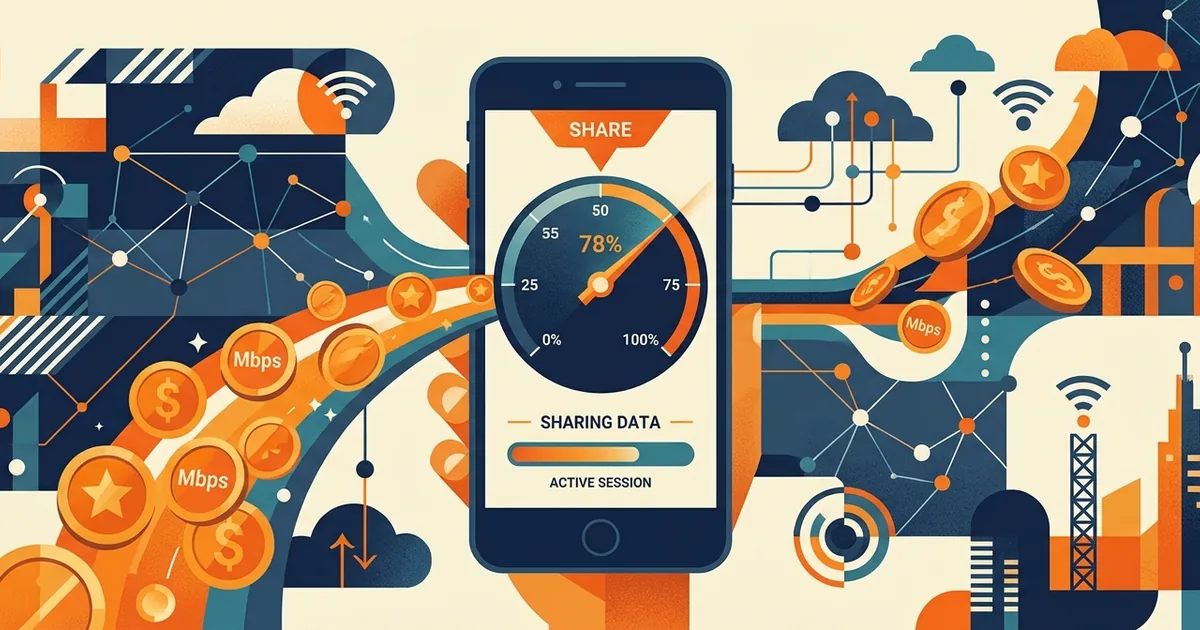
Honeygain pays a small daily amount for sharing unused bandwidth, typically a few cents per device per day, with PayPal and crypto payouts from a $20-equivalent threshold. The rate is low; the real question is whether sharing your connection is acceptable to you and your network's owner.
What you are actually selling
Honeygain routes third-party web requests through your internet connection and pays you a share of the revenue. You are not selling clicks or attention - you are selling a slice of your IP address and bandwidth to businesses that need residential traffic, typically for price comparison, ad verification and brand protection.
That framing matters more than the rate. The question is not "is a few cents a day worth it" but "am I comfortable with my connection carrying someone else's traffic".
What it pays per device
| Factor | Detail | Effect |
|---|---|---|
| Daily rate | A few cents per device | Low, scales with devices |
| Traffic cap | Per-day limit per device | Caps the upside |
| Payout | PayPal or crypto | From a $20-equivalent threshold |
| Location | Higher rates in some markets | Rate varies by country |
Never run it on a network you do not own
A university, employer or shared connection is not yours to sell. Running Honeygain there is a terms violation for you and a security question for the network owner, and it can cost you access.
The questions worth settling first
Traffic on your connection is traffic attributed to your IP. In practice Honeygain's traffic is ordinary web requests, but the general principle holds: anything that leaves your network is associated with your address. Decide that trade-off deliberately rather than by accident.
Use a dedicated device if you can. Running it on the machine you bank from, or on a phone with sensitive apps, concentrates risk for a very small reward.
Some internet contracts restrict reselling or sharing the connection for commercial use. Read yours before running a bandwidth-sharing app continuously, and stop if the terms prohibit it.
Who should use Honeygain
Honeygain makes sense if you own an unmetered connection, have a spare device, and are comfortable with the traffic model. It does not make sense on a metered plan, on a network you do not own, or on the device you use for banking.
Frequently Asked Questions
Is Honeygain legit?
Yes, it has paid for years and is one of the best-known bandwidth-sharing apps. Legitimate does not mean lucrative - the daily rate per device is a few cents.
How much does Honeygain pay per device per day?
A few cents, capped by a daily traffic limit and varying by country. Adding devices multiplies the total but not the per-device rate, and each device needs its own connection.
Is Honeygain safe?
The traffic is ordinary web requests, but it does leave your IP. Use a spare device, not the machine you bank from, and avoid running it on a network you do not own.
What is the Honeygain minimum payout?
Around a $20-equivalent threshold, paid by PayPal or in crypto. At a few cents per device per day, reaching it takes months on a single device.
Can I run Honeygain on my work or university wifi?
No. You would be selling a connection you do not own, which breaches both the network's rules and the app's terms, and can cost you access.
Verdict
Honeygain is a real payer with a genuinely low rate. Treat it as spare-capacity monetisation on hardware and a connection you own, never as income.
Keep it off metered plans and off any device or network where you would not want your IP associated with third-party traffic.
Other ways to earn beyond this guide
Sponsored partner offers for readers who want a second income stream alongside PTC tasks. These links are paid placements — the partner sets the terms, the rewards and the payout.
See the sponsored offers →Opens a partner page in a new tab. This is not a CatPTC task and does not credit your CatPTC balance.
Test CatPTC with the $1.50 signup bonus
Registration costs nothing, needs no card, and new members get $1.50 credited instantly.
Create your free account →No deposit required to start. Withdrawals in BTC, ETH, LTC, DOGE or USDT.