Nobody targets a PTC account for the balance. A few dollars is not worth a criminal's time. What makes these accounts attractive is what sits behind them: a working email address, a reused password, and very often a crypto wallet address that has been used to receive payouts. An attacker who gets into your PTC account does not just take your balance — they take a credential that may unlock your email, your exchange account or your wallet, and they learn exactly how you move crypto, which makes the next step far easier.
That is the uncomfortable truth about security in this niche: the risk is not proportional to what you earn. PTC users are targeted precisely because they are casual, because they are numerous, and because a large fraction of them reuse the same password across platforms and hold their crypto with no meaningful protection. This guide covers why these accounts get hit, how to lock yours down properly, and what to do in the specific and unpleasant event that you are breached.
PTC accounts get targeted because they hold a reusable credential plus a crypto address, not because of the balance. The three defences that matter most are a unique password for every platform stored in a password manager, two-factor authentication using an authenticator app rather than SMS, and a withdrawal address you verify every single time. Together those three stop the overwhelming majority of attacks. The rest is vigilance about phishing links and keeping your payout wallet separate from your main holdings.
Why PTC accounts get targeted
The economics of attacking an account are simple: an attacker spends effort where the expected return is highest relative to the work involved. A single high-value bank account is hard to reach and well defended. Ten thousand casual earning accounts, each with a reused password and no two-factor authentication, are easy to reach in bulk and collectively worth a great deal — not for their balances, but for what they open up.
There are three specific things that make a PTC account valuable, and understanding them explains every defence in this guide.
The first is credential reuse. Most people who use one online-earning platform use several, and a large fraction use the same email and password across all of them, their email provider, and sometimes their exchange. Breach one, and you have breached everything that shares those credentials. This is why a data breach at a small platform you barely remember can lead to your email being compromised months later.
The second is the crypto address. Anyone inside your account can see the withdrawal addresses you have used, the platforms you use, and how you move funds. That is reconnaissance. It tells an attacker where to direct a future payment, and it identifies you as someone who holds crypto and may be worth pursuing elsewhere.
The third is low suspicion. Casual users are less likely to notice an unfamiliar login, less likely to have alerts enabled, and less likely to act decisively when they do. Attackers choose easy targets, and a platform full of beginners is a large pool of them.
Think of it as a key, not a wallet
The balance in your PTC account is the least valuable thing it contains. What matters is whether the credentials for that account also unlock your email, your exchange, or anything else that holds real money. Treat every login as potentially the key to something more important — because if you reuse passwords, it is.
Strong passwords and password managers
The single highest-value change you can make is to stop reusing passwords. Almost every serious account compromise begins with credentials that were valid somewhere else. Making each password unique defeats that entire class of attack at once.
The obstacle, of course, is memory: nobody can hold thirty unique strong passwords. That is exactly what a password manager is for. It generates a long random password for every site, stores them encrypted behind a single strong master password, and fills them in automatically. You memorise one passphrase and the manager handles the rest.
| Practice | Risk level | What to do instead |
|---|---|---|
| Same password on every site | Critical | Unique password per platform, in a manager |
| Short or predictable password | Critical | Long passphrase or generated random string |
| Password in a notes app or browser only | Risky | Dedicated encrypted password manager |
| Unique password, written on paper at home | Moderate | Acceptable but harder to back up |
| Unique password in a password manager | Best | Keep the master passphrase strong and offline |
Two details matter when you set this up. First, the master passphrase should be long rather than complex — four or five unrelated words make a far stronger and more memorable key than a short string of symbols. Second, secure the recovery path: if you lose access to the manager, you lose access to everything inside it, so keep the recovery codes somewhere offline and physically separate.
Start with your email
If you change one password today, change the one for your email account. Almost every other account in your life resets its password by email, which means whoever controls your inbox controls everything else. A unique, strong email password plus two-factor authentication on the inbox is the single most protective thing you can do — more valuable than anything you do for the PTC accounts themselves.
Two-factor authentication explained
Two-factor authentication (2FA) is a second proof of identity beyond your password, and it is the second defence that closes off the credential-reuse problem. Even if an attacker obtains your password, they cannot log in without the second factor.
There are several kinds, and they are absolutely not equivalent. Choosing the right one matters more than enabling any of them.
| 2FA method | Security | Notes |
|---|---|---|
| Authenticator app (TOTP) | Strong | Codes generated on your device, not sent over a network |
| Hardware security key | Strongest | Requires a physical device; best where supported |
| SMS code | Weak | Vulnerable to SIM-swap; better than nothing only |
| Email code | Weak | Fails if your email is already compromised |
| No 2FA | Critical | The most common single point of failure |
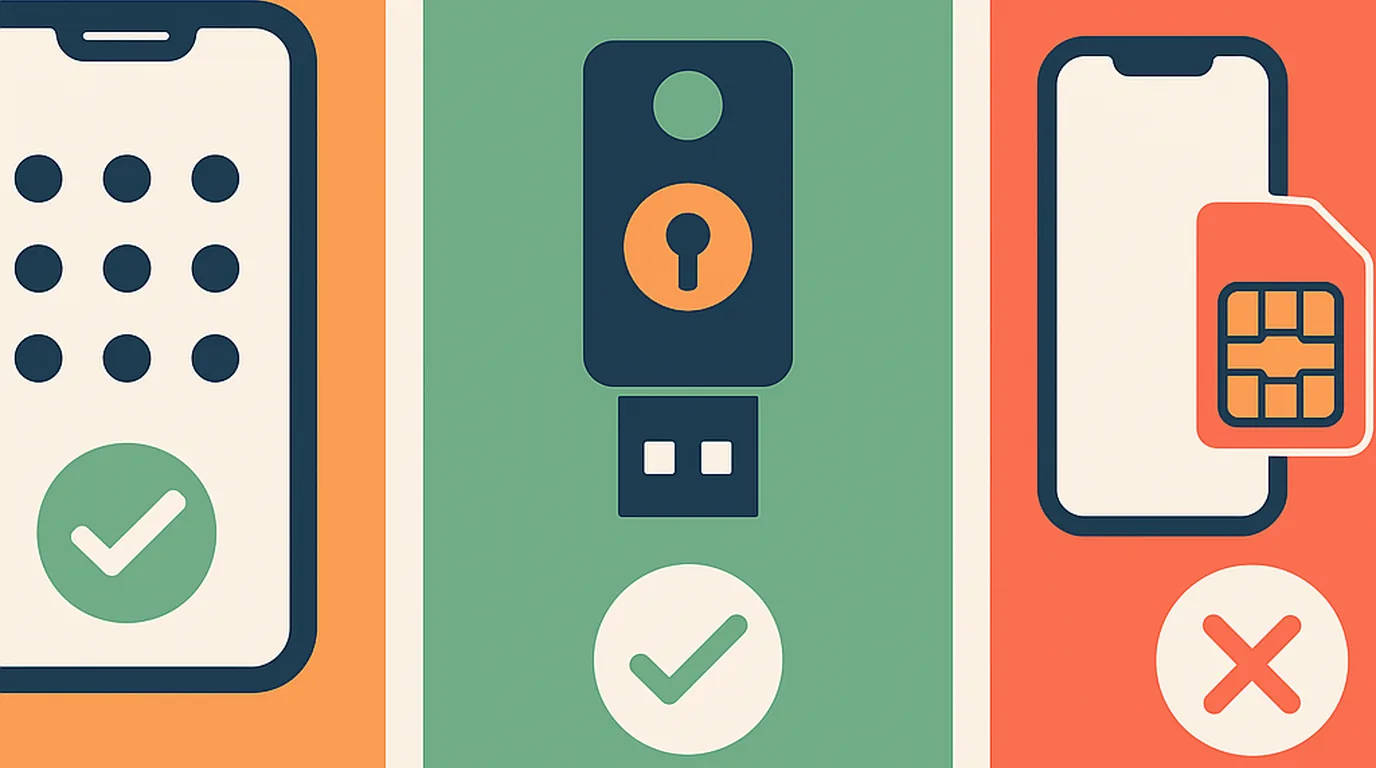
An authenticator app generates a six-digit code every thirty seconds on your own device, with no message travelling over a network to intercept. SMS codes, by contrast, are vulnerable to SIM-swap fraud: an attacker convinces your mobile provider to move your number to a SIM they control, and every code thereafter arrives with them. That attack is the reason SMS 2FA is considered a weak second factor rather than a strong one, and why an authenticator app should be your default wherever a platform offers a choice.
When you enable 2FA on any account, save the backup or recovery codes immediately. They are your only route back in if you lose the device, and losing both the device and the codes can lock you out of your own account permanently. Store them offline, printed or in a separate secure location — not in the same app that generates your codes.
Spotting phishing emails and fake logins
Phishing bypasses your password, your 2FA and your password manager entirely by convincing you to hand over your credentials yourself. It is the most common way earners lose accounts, and it exploits nothing more sophisticated than urgency.
The pattern is consistent. You receive an email that looks like it comes from a platform you use, warning that your account is at risk, that a withdrawal is pending, or that you must verify your identity. It contains a link. The link leads to a page that looks exactly like the real login page, where you enter your email, password and — if they are thorough — the 2FA code you just generated. They now have everything.
Never click the link in the email
The single habit that defeats almost all phishing is simple: do not log in through a link you were sent. Open a new browser tab, type the site's address yourself, or use a bookmark you created earlier, and log in from there. If the warning in the email was real, it will be visible in your account. If it was fake, you have just sidestepped it entirely.
Beyond that habit, four details reliably give a phishing page away. The domain name is subtly wrong — a character swapped, an extra word, a different ending. The link destination does not match the visible text when you hover over it. The message creates urgency, demanding action within hours. And the page asks for more than a login — your seed phrase, your full card number, or a password you would never normally type there.
Two categories of request should end the conversation instantly. No legitimate platform will ever ask for your crypto wallet seed phrase, ever, for any reason, and no legitimate platform will ask for your mobile-money PIN or a payment card PIN. Both requests are categorical proof of fraud. Regulators describe these patterns consistently, and the SEC's Investor.gov resources on fraud and advance-fee schemes are a plain-language reference worth reading even outside the United States.
Securing your crypto wallet
Because most PTC payouts now arrive as crypto, the security of your receiving wallet matters as much as the security of the platform. The key idea is separation: the wallet that receives small payouts should not be the wallet where you hold anything significant.
A practical setup has three parts. A hot wallet — a software wallet on your phone or computer — receives payouts and holds small balances for convenience. A hardware wallet or an exchange account holds anything larger, accessed less often. And the seed phrase, the twelve or twenty-four words that can restore the wallet, is written down on paper and stored offline, never photographed, never typed into any website, never stored in cloud notes.
| Asset / secret | Where to keep it | Never |
|---|---|---|
| Small payout balances | Hot wallet on your device | Leave indefinitely without withdrawing |
| Larger holdings | Hardware wallet or reputable exchange | Keep in the same hot wallet you receive to |
| Seed phrase | Written on paper, offline, in one or two safe places | Photograph, cloud notes, or type into a site |
| Exchange login | Unique password plus authenticator-app 2FA | Reuse a password from another site |
| Withdrawal addresses | Verify in-app every time | Trust a pasted address without checking |
The seed phrase is the crux of everything. Anyone who has those words can restore your wallet and take everything in it, on any device, without needing your password or your device at all. There is no support line to call and no reversal. Treating the seed phrase as the most sensitive secret you own — more sensitive than any password — is the whole of wallet security.
One more habit is worth forming. Before every withdrawal, verify the destination address character by character against the source you trust, or copy and re-check. Malware that silently swaps a copied crypto address for the attacker's is common, and it defeats the careful user who pastes without looking. Our guide on how to withdraw crypto from a PTC site safely covers the full process.
What to do if you get hacked
If you suspect your account has been compromised, speed matters far more than perfection. Work through these steps in order, even if you are not yet certain.
- Change your email password first. Your inbox is the reset route for everything else, so secure it before anything else. If you are locked out of the email itself, use your provider's account recovery immediately.
- Change the passwords for every account that shared the same credentials — not just the compromised one. Reuse is how a single breach becomes many.
- Secure your crypto first. If a wallet or exchange is involved, move funds to a new wallet whose seed phrase the attacker has never seen, and revoke any connected-app permissions you do not recognise.
- Enable or reset 2FA, using an authenticator app rather than SMS, and save the new backup codes.
- Contact the platform's support with dates, times and any evidence, and ask them to secure the withdrawal address on your account. Recovery is not guaranteed, but a fast report improves the odds.
- Check your devices for malware or an unfamiliar browser extension, particularly if the compromise involved a wallet. Removing the cause prevents a repeat.
- Warn the community. Leave an honest review on Trustpilot describing what happened, and report the incident to your national consumer or cybercrime authority. Your report is what protects the next person.
Two things are worth saying plainly about recovery. First, crypto transfers are irreversible — there is no chargeback, and no platform can claw back funds that have already left. Second, if the attacker was able to complete a withdrawal, the money is almost certainly gone; the goal of the steps above is to stop the damage spreading to your email, your exchange and your remaining holdings, not to recover what has already left.
Security checklist
Here is the whole guide condensed into actions. If you do nothing else, do the first three — they prevent the great majority of realistic attacks.
- Use a unique password for every platform, stored in an encrypted password manager.
- Turn on two-factor authentication everywhere, using an authenticator app rather than SMS.
- Verify your withdrawal address every single time before confirming a withdrawal.
- Give your email account the strongest protection you have, since it is the reset route for everything else.
- Never log in through a link in an email. Navigate to the site yourself, or use your own bookmark.
- Never share a seed phrase, PIN or full card number. No legitimate platform will ever ask for any of them.
- Keep small payout balances separate from anything you would be upset to lose.
- Save 2FA backup codes offline, separate from the device that generates the codes.
- Log out of shared computers, and avoid managing accounts on public or borrowed devices.
- Review your accounts monthly for unfamiliar logins, changed withdrawal addresses or unexplained balance changes.
The honest summary: PTC accounts are targeted because they carry a reusable credential and a crypto address, not because of the balance inside them. That means the security you need is the same security you need everywhere — unique passwords, real two-factor authentication, a protected email account and a carefully kept seed phrase — applied with particular discipline because the target on your back does not match the size of what you earn.
For the practical withdrawal side, our guide to withdrawing crypto from a PTC site safely walks through the process, and our explainer on USDT TRC20 vs ERC20 covers choosing a network. If you are still evaluating platforms, our guide on how to spot a scam PTC site complements this one, and the best PTC sites of 2026 covers the wider market.
Frequently Asked Questions
Why would anyone hack a PTC account with so little money in it?
Because the balance is not the point. A PTC account holds a reusable credential and a crypto withdrawal address, plus a working email. An attacker who gets in gains a password that may also unlock your email, exchange or wallet, and reconnaissance on how you move crypto. Casual earning accounts are targeted in bulk precisely because they are numerous and usually unprotected.
What is the most important thing I can do to secure my PTC account?
Stop reusing passwords. Almost every account compromise begins with credentials that were valid somewhere else, so making every password unique and storing it in a password manager defeats that entire class of attack at once. Do that, then add authenticator-app two-factor authentication and verify your withdrawal address before every payout.
Is SMS two-factor authentication good enough?
It is better than nothing but weaker than an authenticator app, because SMS codes are vulnerable to SIM-swap fraud. In that attack an attacker convinces your mobile provider to move your number to a SIM they control, so every code thereafter reaches them. Use an authenticator app or a hardware key wherever a platform offers the choice.
How do I spot a phishing email pretending to be a PTC site?
The reliable habit is never to log in through a link you were sent. Open a new tab and type the site address yourself, or use your own bookmark. Beyond that, check that the domain is exactly right, hover over links to see their true destination, and treat urgency as suspicious. Any request for your seed phrase, a PIN or a full card number is proof of fraud.
What should I do if my PTC account is hacked?
Work in order and quickly. Change your email password first, since it is the reset route for everything else. Then change every password that was reused elsewhere, move any crypto to a new wallet, reset two-factor authentication, and contact the platform's support. Afterwards warn the community on Trustpilot and report it to your national consumer or cybercrime authority. Crypto transfers are irreversible, so speed matters more than perfection.
CatPTC partner plans carry capital at risk, and a published return is not a guarantee of future performance. Task earning involves no deposit and therefore no capital at risk. Earnings depend on the tasks you complete. Nothing in this article is financial advice.
See what each CatPTC task pays before you click
Every task shows its reward and timer up front — plus a $1.50 signup bonus to get started.
Create your free account →Registration takes under a minute and needs no card.

The CatPTC editorial team researches paid-to-click platforms hands-on — verifying payout terms, withdrawal records and trust signals before publishing. Every guide is fact-checked against live platform data and updated whenever terms change.