
Most paid-to-click scams are not sophisticated. They are simple traps that rely on one thing: a user who is excited enough about earning that they skip the obvious question. But there is a smaller, more dangerous category that deserves its own warning — sites that deliberately wear the language of paid-to-click while operating as an investment scheme, where your earnings are not paid for attention but funded by the deposits of the people who arrived after you.
That structure is a Ponzi scheme, and it is the reason this particular corner of the earning world has such a bad reputation with regulators. This guide explains what makes a PTC site a Ponzi scheme rather than a business, how the "investment PTC" model works, the specific red flags that give it away, what the SEC warns about, and how to protect yourself with a test you can apply in about thirty seconds.
A legitimate PTC site earns money from advertisers and pays you for viewing ads. A Ponzi PTC site earns money from new members' deposits and pays earlier members out of those deposits, so the "returns" are simply other people's money. The detecting test is simple: legitimate PTC pays you for attention and never requires you to pay; Ponzi PTC requires a deposit, promises guaranteed or daily returns, and often rewards recruiting. If the site takes money from you before it gives any, it is not paid-to-click.
What makes a PTC site a Ponzi scheme
Start with how a legitimate PTC platform makes money, because the contrast is the whole point. An honest PTC site sells advertising space. Advertisers pay to put their page in front of users, the platform keeps a margin, and it passes a defined share of that revenue to you as a reward for viewing the ad. The money flows from advertiser to platform to user, and it is generated by a real economic activity — attention delivered.
A Ponzi PTC site inverts that flow. Instead of earning from advertisers, it earns from its own members. Members are asked to deposit money, usually framed as a "plan", an "upgrade" or an "investment package", and the returns paid to earlier members are funded not by advertising revenue but by the deposits of later members. The activity being presented as the source of returns — clicking ads — is window dressing. The real cash flow is new deposits paying old withdrawals.
That structure has a mathematical certainty attached to it. A Ponzi scheme cannot continue indefinitely, because the money owed to members must keep growing faster than the money arriving from new members. Eventually the arrival of new deposits slows — because the pool of willing participants is finite and the pitch gets less believable — and at that moment the scheme collapses. Withdrawals stop processing, the site goes quiet, and the operators disappear. This is not a risk that can be managed; it is the defined endpoint of the model.
What makes PTC an attractive disguise for this structure is the category's own normalcy. Tiny payments, crypto withdrawals, referral commissions and daily tasks are all perfectly ordinary features of legitimate PTC platforms. A fraudster can reproduce all of them, add a deposit mechanism, and produce something that looks at a glance like a slightly ambitious version of a normal site. The disguise works because the honest and dishonest versions share so much surface.
How "investment PTC" models work
The "investment PTC" is the most common expression of the scheme, and its mechanics are worth understanding precisely, because once you can see the shape you cannot unsee it.
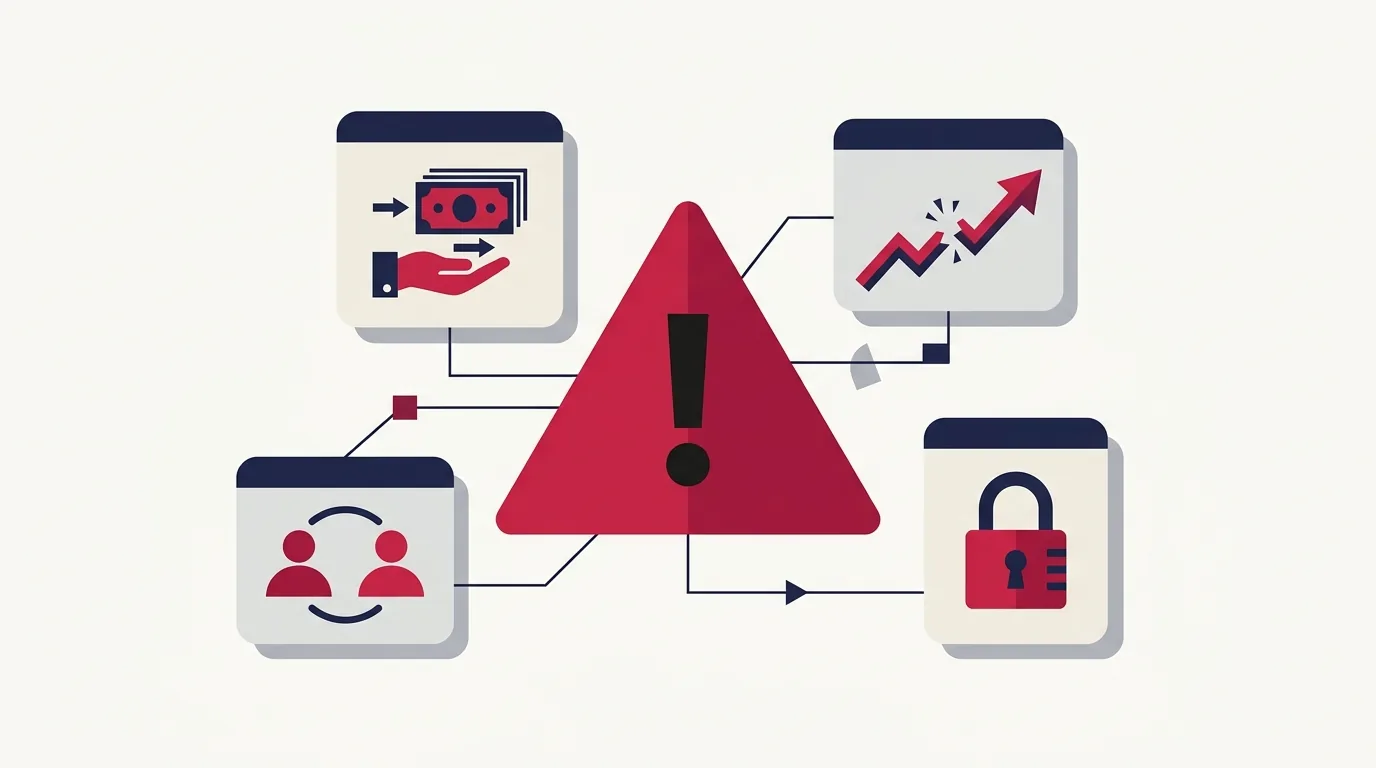
The site presents a tiered menu of "plans". A modest deposit unlocks a higher daily click rate; a larger deposit unlocks more. Each plan advertises a return — often expressed as a percentage per day, or as a fixed daily sum — and the implied annual rate is always extraordinary, frequently running into hundreds or thousands of percent. There is usually a timer, a countdown, or a scarcity claim to encourage a decision before you have time to think.
Early participants often do receive payments. This is not evidence of legitimacy; it is the mechanism. Paying the first wave is what generates the testimonials and screenshots that recruit the second wave, whose deposits fund the first wave's withdrawals. The scheme depends on those early payouts being genuine enough to be shared, so some money genuinely moves — just not from anywhere sustainable.
The recruiting layer is usually present too, because a Ponzi scheme needs a growing inflow of deposits to survive, and the cheapest way to get new deposits is to have existing members bring them in. You will often see referral commissions far more generous than any legitimate platform's, and sometimes a structure where your ability to withdraw is tied to the number of people you have introduced. That linkage is a very strong signal: an honest PTC site never makes your payout depend on signing up other people.
The inversion to remember
A legitimate PTC site pays you to look at ads and never asks for money. An investment PTC site asks for money and describes ads as the reason you are being paid. If the platform's revenue comes from members rather than advertisers, the advertising is decoration and the returns are other people's deposits.
Red flags: guaranteed returns and deposit demands
Individual scam sites vary in presentation, but the warning signs are remarkably consistent. Any one of the following should stop you; several together make the conclusion almost certain.
| Red flag | What you will see | Why it matters |
|---|---|---|
| Deposit required to earn | "Activate your account", "buy a plan", "minimum deposit" | No legitimate PTC site requires this |
| Guaranteed or fixed returns | "Earn X% daily", "guaranteed profit" | Implies funding from deposits, not advertising |
| Implausible yield | Hundreds or thousands of percent annually | No advertising business can support such returns |
| Withdrawal tied to recruiting | Must refer N people to withdraw | The signature of a pyramid structure |
| Extreme referral bonuses | Commissions far above industry norms | Rewards recruitment over activity |
| Rising withdrawal thresholds | Minimum increases as you approach it | Designed so you never collect |
| Urgency and pressure | Countdowns, "limited spots", expiring bonuses | Prevents you from checking the maths |
| No verifiable identity | No company details, anonymous operators | Nothing to hold accountable when it fails |
The single most decisive entry in that table is the first one. Everything else is a signal; a demand for a deposit is a definition. Legitimate paid-to-click platforms pay you for attention and have no reason to require your capital — their revenue comes from advertisers. The moment a site asks you to fund your own account before you can earn from it, the business model has changed, whatever the marketing says.
The second most important is the recruiting linkage. Referral programmes are normal and fine; every real platform has one. But when your ability to withdraw depends on bringing in other people, the site is not paying you for clicking — it is paying you for recruitment, and the money for that payment has to come from somewhere other than advertising.
What the SEC warns about
Regulators describe these schemes in consistent terms, and the general framework is worth knowing because it applies far beyond any single site. The U.S. Securities and Exchange Commission's investor education resources explain that in a Ponzi scheme, returns are paid to earlier investors using the money contributed by newer investors, rather than from genuine profit or revenue. The Commission's guidance at investor.gov sets out the characteristic features: promises of high returns with little or no risk, unusually consistent returns regardless of market conditions, unregistered or unlicensed sellers, and difficulty obtaining clear information about the business.
Read that list against an "investment PTC" pitch and the overlap is immediate. A promised daily percentage with no risk is exactly the "high returns, low risk" pattern. Returns that arrive on a fixed schedule regardless of how much advertising the platform actually sells are the "consistent returns" warning. Operators who cannot be identified are the "unregistered seller" warning. And a site that will not explain clearly where its revenue comes from is the "difficult to get information" warning.
There is an important limitation to keep in mind, and it is one regulators themselves acknowledge: the fact that a scheme operates offshore, or pays in cryptocurrency, makes investigation and recovery far harder. Enforcement is slow, cross-border cooperation is imperfect, and by the time an action is announced the funds have often moved. Which is why prevention — applying the test before you deposit, not after — matters more here than in almost any other financial decision.
Use the regulator as a reference, not a rescue
Investor-protection guidance is most valuable before you act. Read the SEC's descriptions of Ponzi and advance-fee schemes and you will recognise the pattern the next time it is presented to you in PTC clothing. Relying on a regulator to recover your deposit after a collapse is a losing plan; recognising the structure in advance is the whole defence.
Real examples and recurring patterns
Specific sites come and go, and naming them is less useful than recognising the pattern they all share — because the next one will have a different name and the same shape. What follows are the recurring outlines seen across this category.
The "high-yield clicks" platform. It advertises an unusually high rate per click — several times the category norm — and requires a paid upgrade to access it. The high rate is the bait; the upgrade is the real product. Early upgraders are paid, their screenshots circulate, and the wave that follows funds those payouts until deposits slow.
The "package" site. It sells named investment packages with escalating advertised returns and encourages members to "reinvest" earnings rather than withdraw. Reinvestment is particularly dangerous, because it converts money you have already earned into a larger claim on a scheme that cannot pay it, and it delays the moment you would otherwise notice that withdrawals have stopped working.
The forced-recruitment platform. Withdrawal is conditional on introducing a set number of new members. This is the clearest pyramid structure and, unsurprisingly, the one most likely to attract regulatory attention, since it requires continuous recruitment to function at all.
The "cash-out fee" trap. After you accumulate a balance, the site reveals a fee — a withdrawal charge, a tax payment, an account upgrade — that must be paid before your money is released. Paying it does not release the money; it just produces another charge. This is a classic advance-fee scheme rather than a pure Ponzi, but it is often found alongside the same PTC branding.
Across all four, the common thread is that money flows from you to the platform under a label that promises it will flow back. That is the one thing a genuine PTC platform never does.
How to protect yourself
Protection here is not complicated; it is mostly a matter of refusing to skip a few checks under the pressure of a good pitch.
- Never deposit money into an earning site. This single rule defeats almost every PTC Ponzi scheme, because the model requires your capital to function. A legitimate platform pays you for attention and needs no money from you.
- Ask where the revenue comes from. If the answer is not clearly "advertisers pay for attention", treat it as unresolved. Vague talk of "our trading team" or "our investors" is a warning, not an answer.
- Check the maths of any advertised return. A promised daily percentage annualises to an absurd figure within seconds. If the number is not one that any real advertising business could pay, it is being funded by deposits.
- Refuse anything conditional on recruiting. If your withdrawal depends on bringing in other people, walk away regardless of how the rest of the site looks.
- Verify the operator. Look for a named company, a registered address and any regulatory footprint. Absence of all three is a strong negative signal.
- Read independent reviews before committing time. Check platforms such as Trustpilot, and read the critical reviews rather than the enthusiastic ones — the negative reviews are where payment failures are reported.
- Test with the minimum, and withdraw early. On any platform you do use, reach the lowest possible withdrawal and take it. A platform that will not pay a small amount cheaply will not pay a large one later.
The rule that covers every variation
Whatever the branding, the test does not change: a legitimate PTC site pays you for attention and never asks you to pay. If money must flow from your account to theirs before you can be paid — as a deposit, an upgrade, a plan, an activation fee or a cash-out charge — it is a scam. For a fuller breakdown of the warning signs, see our guide on how to spot a scam PTC site.
Legit vs Ponzi: the quick test
When you want a fast verdict, run the comparison below. It takes less than a minute and it does not require any technical knowledge.
| Question | Legitimate PTC site | Ponzi PTC site |
|---|---|---|
| Where does revenue come from? | Advertisers | Member deposits |
| Do you have to pay to earn? | No | Yes — that is the product |
| Are returns guaranteed? | No returns promised at all | Yes, often daily |
| Is withdrawal tied to recruiting? | No | Frequently |
| Can you see the rate per task? | Yes, before you click | Often obscured |
| Is the operator identifiable? | Usually | Often anonymous |
| What is the earning basis? | Attention | Capital |
The column on the right is not a checklist you need to complete. Any single "no" in the Ponzi column is enough to justify walking away, and the first two are conclusive on their own. A site that takes your money to let you earn, and pays returns that no advertising business could fund, is not a PTC platform with an unconventional model — it is an investment scheme using PTC as a costume.
If you want to build your earning on solid ground instead, our best PTC sites of 2026 guide ranks platforms by rates and minimums, our how to start earning on PTC sites walkthrough covers the first steps, and our guide on how to spot a scam PTC site adds further checks. For the payment side, our comparison of PTC payment methods explains how legitimate withdrawals work.
The honest summary: a Ponzi PTC site is not an unusually generous paid-to-click platform. It is a different business entirely, wearing the vocabulary of PTC to make a deposit look like an investment. The distinguishing features are not subtle once you know them — money flows in from members rather than advertisers, returns are promised rather than earned, and recruiting is eventually required. Apply the test before you deposit, and the trap stops working.
Frequently Asked Questions
Are PTC sites Ponzi schemes?
No. A legitimate PTC site earns revenue from advertisers and pays you for viewing their ads, so the money comes from a real economic activity and you are never required to pay. A Ponzi PTC site is a different business entirely: it earns from members' deposits and pays earlier members out of those deposits. The category is legitimate; a specific subset of sites deliberately misuse the PTC label to disguise an investment scheme.
What is the clearest sign that a PTC site is a Ponzi scheme?
A demand for a deposit before you can earn. Legitimate PTC platforms pay you for attention and have no reason to require your capital, because their income comes from advertisers. The moment a site asks you to buy a plan, activate an account or make a minimum deposit before earning, the revenue model has changed to member deposits — which is the definition of the scheme, whatever the marketing calls it.
Why do some people get paid by a Ponzi PTC site at first?
Because paying the first wave is the mechanism, not evidence of legitimacy. Early payouts generate the testimonials and screenshots that recruit the next wave of deposits, and those later deposits are what fund the earlier withdrawals. That is why the scheme feels real for a while and then stops abruptly when new deposits slow down, which is the mathematically certain endpoint of the model.
What does the SEC say about these schemes?
The SEC's investor education resources explain that in a Ponzi scheme, returns are paid to earlier investors using money contributed by newer investors rather than from genuine revenue. The characteristic features it lists include promises of high returns with little or no risk, unusually consistent returns, unregistered sellers, and difficulty obtaining clear information about the business. An investment PTC pitch typically exhibits several of these at once. Offshore operation and crypto payments make enforcement slow and recovery unlikely, so prevention matters most.
How can I check whether a PTC site is legitimate?
Apply a few checks before committing any time or money. Never deposit funds. Ask where revenue comes from and require a clear answer of advertisers paying for attention. Annualise any promised return to see if it is implausible. Refuse anything conditional on recruiting others. Look for a named operator and any regulatory footprint. Read critical reviews on Trustpilot rather than enthusiastic ones, and test any platform with the lowest possible withdrawal early to confirm it actually pays.
CatPTC partner plans carry capital at risk, and a published return is not a guarantee of future performance. Task earning involves no deposit and therefore no capital at risk. Earnings depend on the tasks you complete. Nothing in this article is financial advice.
See what each CatPTC task pays before you click
Every task shows its reward and timer up front — plus a $1.50 signup bonus to start with.
Create your free account →Registration takes under a minute and needs no card.

The CatPTC editorial team researches paid-to-click platforms hands-on — verifying payout terms, withdrawal records and trust signals before publishing. Every guide is fact-checked against live platform data and updated whenever terms change.