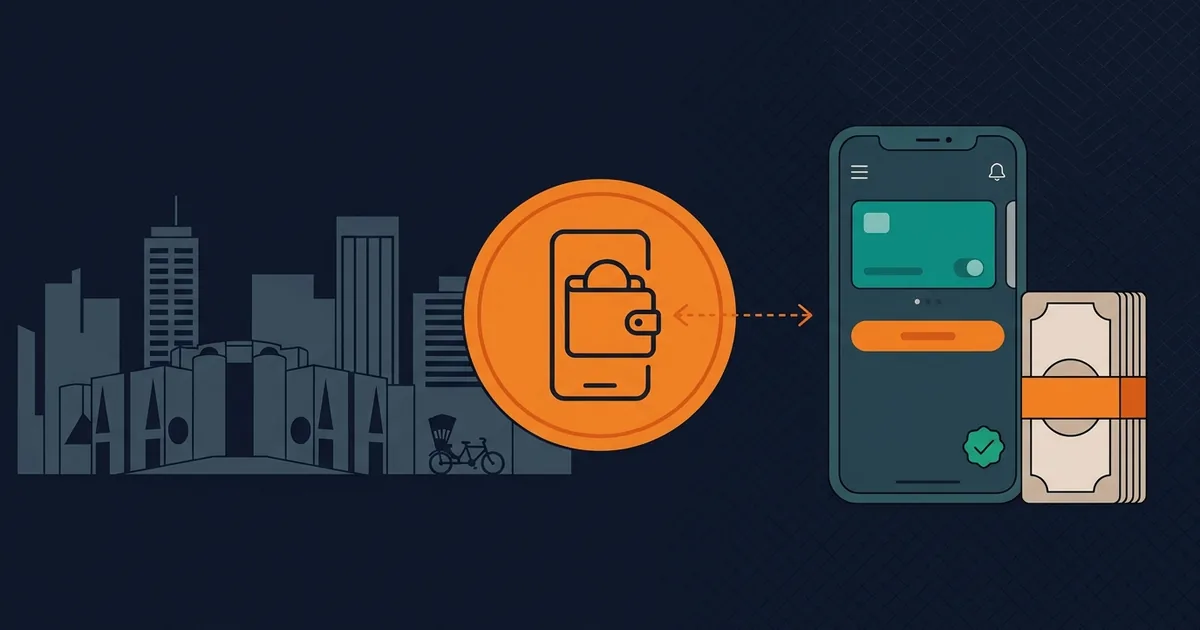
Bangladesh solved the receiving problem years ago. bKash, Nagad and Rocket interoperate, agent coverage reaches villages, and a member without a bank account can be paid in minutes. If you are being paid, the hard part is over.
The hard part is what happens between the platform and the wallet. That leg crosses a currency, a rail and a fee stack, and it is where a taka balance quietly shrinks. This guide works through the actual arithmetic — wallet cash-out charges, the crypto-to-taka route, and the thresholds at which a withdrawal stops being worth making.
A bKash agent cash-out runs about 1.85%, or roughly Tk 13–19 per Tk 1,000, and Nagad is usually cheaper on small amounts. Add the crypto-to-taka leg and a typical PTC payout loses 8–15% end to end. The fix is not a better platform — it is fewer, larger hops: batch to a threshold where the fixed costs fall below 10% of the amount.
The last mile is the whole problem
Most advice for Bangladeshi members is about which platform to join. That is the wrong question when the platform pays reliably and the money still arrives 15% lighter than the balance you requested.
Think of the chain as four hops, each with its own cost:
- Platform withdrawal — often free, sometimes a flat fee, almost always with a minimum.
- Network fee — if the payout is crypto, the chain charges to move it. Cents on TRC20, several dollars on ERC20.
- Conversion — USDT into taka, through an exchange or a peer-to-peer desk. This carries a spread.
- Cash-out — taka sitting in a wallet becoming cash in your hand, at the agent counter.
Only the fourth hop is visible to most people, because it is the one with a printed receipt. The first three are real and two of them are larger.
What the wallets actually charge
Cash-out charges in Bangladesh have been remarkably stable and remain one of the most complained-about costs in the sector. Across the three major providers the range sits at roughly Tk 12.99 to Tk 18.50 per Tk 1,000 withdrawn.
| Wallet | Cash-out on Tk 1,000 | Effective rate | Where it wins |
|---|---|---|---|
| bKash | ~Tk 18.50 | ~1.85% | Widest agent and merchant network; the default when you need to spend digitally |
| Nagad | ~Tk 13–15 | ~1.3–1.5% | Small, frequent amounts; usually the cheaper counter |
| Rocket | ~Tk 15–18 | ~1.5–1.8% | Bank-linked accounts; useful where agent density is thin |
The spread between them is a few taka per thousand, which sounds trivial until you compare it to the platform rate. Clicking earns fractions of a cent. A taka saved at the counter is worth more clicking time than most members realise.
The asymmetry nobody mentions. Cashing out Tk 10,000 through mobile financial services costs close to Tk 200. Moving the same amount through a bank costs roughly Tk 29. The wallet is convenient, not cheap — and at larger amounts a bank transfer is the rational choice.
The crypto-to-taka route, step by step
Almost no PTC platform pays directly into bKash. The realistic chain is: platform pays USDT, you sell it to a local buyer for taka, the taka lands in your wallet. Four decisions determine whether that is cheap or expensive.
1. Which network
USDT moves on several chains at wildly different prices. TRC20 costs cents; ERC20 can cost several dollars. On a $10 payout that difference is the entire margin. Always set the withdrawal network deliberately — see USDT TRC20 vs ERC20.
2. Which venue
A peer-to-peer desk usually gives a better taka rate than an exchange's order book, because the counterparty wants dollars and will pay a premium for them. The trade-off is counterparty risk. Use escrow, always, and never release before the taka is confirmed in your wallet.
3. Which wallet receives
If you are going to cash out immediately, receiving into Nagad saves a little. If you are going to pay bills or buy airtime, bKash's merchant coverage saves more than the fee difference.
4. When
Batch. The fixed component — network fee plus the P2P desk's minimum spread — does not care how large the transfer is.
The arithmetic, in taka
Two withdrawals of the same total, run through the same chain. Round figures, illustrative.
| Step | One Tk 4,000 withdrawal | Four Tk 1,000 withdrawals |
|---|---|---|
| Requested | Tk 4,000 | Tk 4,000 (4 × 1,000) |
| Network fee | −Tk 35 | −Tk 140 (4 × 35) |
| P2P spread (~1.5%) | −Tk 59 | −Tk 58 |
| Wallet cash-out (~1.4%) | −Tk 55 | −Tk 56 |
| In hand | Tk 3,851 (96.3%) | Tk 3,746 (93.7%) |
Same platform, same rates, same month. The only difference is the number of hops, and it costs about Tk 105 — roughly two hours of clicking at typical rates. That is the entire argument for batching, expressed in one table.
Thresholds worth knowing before you withdraw
- Platform minimum. Most crypto-paying platforms set a minimum in dollars, often $1–$5. Below it the request sits in pending forever.
- Network minimum. Some chains will not broadcast a dust transfer. Check the venue's deposit minimum, not just the platform's withdrawal minimum.
- P2P desk minimum. Local buyers often refuse trades under a few thousand taka because their own margin does not cover the effort.
- Wallet limits. Monthly outflow limits on a lower-tier account can block a large cash-out. Verify your tier before you plan around a big withdrawal.
What mobile-first actually means for your earnings
Bangladesh is a mobile-first internet market, and that shapes the work more than the payout does.
A PTC session is data-heavy relative to its reward: ad creatives, page weight, and often a video player. On a metered connection the data cost of an hour of clicking can approach the value of the clicks. Members on a daily data pack do better than members paying per megabyte, and members who disable image loading and autoplay do better again.
Two practical adjustments: work in a session rather than scattered through the day, so the page loads are amortised; and prefer platforms with light pages over platforms with heavy ones, even if the advertised rate is slightly lower. The rate is quoted per click. Your cost is per megabyte.
Rules and restrictions that catch people out
Mobile financial services in Bangladesh sit under central-bank direction and are subject to restrictions that have nothing to do with you personally. During national events — elections in particular — cash-in and cash-out have been suspended entirely for multi-day windows, with per-transaction send limits cut sharply.
If you are planning a withdrawal around a date that matters, build in a buffer of several days. A wallet that is frozen by directive for 96 hours will not tell you in advance, and a platform support ticket cannot help.
On the tax side: income from online activity is reportable, and a Tax Identification Number becomes relevant as your totals grow or if you need banking services that ask for one. This is not tax advice — for anything beyond pocket money, a local accountant is worth the fee.
Sources
Cash-out ranges are from published mobile financial services tariff schedules and from reporting on MFS charges in the Bangladeshi press during 2026. Restrictions on cash-in and cash-out during national events are from central-bank directives as reported at the time. Platform rates are site-reported.
Frequently Asked Questions
Can a PTC site pay straight into bKash?
Almost never. A handful of Bangladesh-focused clones integrate a local gateway, but they are the exception and should be tested with a minimum withdrawal before you invest time. The normal route is a crypto payout converted to taka through a peer-to-peer desk or exchange.
How much does bKash cash-out cost on a PTC payout?
Around 1.85% at an agent, or roughly Tk 18.50 per Tk 1,000. Nagad is typically cheaper at Tk 13–15 per Tk 1,000 and is the better choice for small, frequent withdrawals. At larger amounts a bank transfer is cheaper than either.
What is the practical minimum PTC withdrawal in Bangladesh?
It is set by the venue, not the platform. Most crypto-paying sites allow $1–$5, but a peer-to-peer desk may refuse trades below a few thousand taka, and chain fees make very small transfers uneconomic. In practice Tk 2,000–4,000 is the smallest sensible batch.
Is PTC income taxable in Bangladesh?
Income from online activity is reportable, and a TIN becomes relevant as totals grow or when a bank asks for one. This is not tax advice — speak to a local accountant if your earnings are more than pocket money.
Why did my withdrawal get stuck during an election period?
Central-bank directives during national events have suspended cash-in and cash-out for multi-day windows and cut send limits. The platform cannot override that. Build several days of buffer around any date that matters rather than planning to withdraw on the day.
Verdict
Bangladesh's wallets are excellent at moving money and expensive at the counter. The platform you choose matters far less than the number of hops between your balance and your hand: batch to a few thousand taka, pick TRC20 over ERC20, sell through an escrowed P2P desk, and choose Nagad for small amounts and a bank for large ones. Do that and you keep roughly 96% of what you earned instead of 90%.
For the platform side, PTC sites that pay via mobile money covers which ones reach a wallet at all, and low minimum payout sites is the list to start from when your monthly total is small.
Other ways to earn beyond this guide
Sponsored partner offers for readers who want a second income stream alongside PTC tasks. These links are paid placements — the partner sets the terms, the rewards and the payout.
See the sponsored offers →Opens a partner page in a new tab. This is not a CatPTC task and does not credit your CatPTC balance.
Test CatPTC with the $1.50 signup bonus
Registration costs nothing, needs no card, and new members get $1.50 credited instantly.
Create your free account →No deposit required to start. Withdrawals in BTC, ETH, LTC, DOGE or USDT.