
Crypto faucets and paid-to-click sites are neighbours in the same corner of the internet: both pay tiny amounts of crypto for small, repetitive actions, and both attract the same audience of people looking to earn a little without investing anything. Because they look so similar from the outside, they are often treated as interchangeable. They are not.
The two models pay differently, demand different amounts of attention, carry different risks, and suit different goals. A faucet pays you for a few seconds of waiting; a PTC site pays you for a few seconds of looking. Over a month, that distinction produces meaningfully different outcomes. This guide compares them honestly on earnings per action, payout thresholds, time investment and safety — and tells you which one you should actually use.
Both pay small amounts of crypto for tiny actions. Crypto faucets typically pay fractions of a cent per claim, throttle you with cooldowns, and often gate withdrawals behind high thresholds or "shortlink" walls — the weakest earning model of the two. PTC sites pay a defined reward per ad viewed, with clearer rates, lower minimums and more predictable payouts. For almost everyone, PTC is the better use of time; faucets are best treated as a curiosity rather than an earning strategy.
What are crypto faucets?
A crypto faucet is a site or app that dispenses a very small amount of cryptocurrency for a trivial action. The name comes from the early Bitcoin faucets of around 2010, when a developer gave away five bitcoin at a time to anyone who solved a simple captcha. In that era the amounts were genuinely meaningful. Today they are not: a typical faucet claim is worth a fraction of a cent, and the action required is usually a captcha, a short timer, or clicking through an advertisement.
The modern faucet business model is built on advertising. You watch a sponsored page or complete a captcha, the faucet earns advertising revenue, and it passes a tiny sliver of that back to you in crypto. Some faucets are honest about this and simply pay little; others obscure it behind "multiplier" mechanics, level systems and daily bonuses that make the earning feel larger than it is.
Two structural features define the experience. The first is the cooldown: a faucet typically imposes a waiting period of anywhere from a minute to an hour between claims, which caps how much you can earn regardless of how much time you have. The second is the claim ceiling: because the payout per claim is fractions of a cent, you accumulate extremely slowly, and the process of reaching a withdrawal minimum can take weeks or months of daily attention. Those two limits are design choices, not accidents — they keep the advertiser revenue ahead of what you receive.
There is also a category of faucet that is simply not worth engaging with at all. Some require you to complete "shortlinks" or offer-walls before each claim, which converts the faucet into a funnel for other advertising networks. Others promise escalating rewards for depositing crypto or for referring others. Both patterns should set off the same alarm you would apply to any suspect earning site.
What are PTC sites?
A paid-to-click site pays you a defined amount for viewing an advertisement for a set number of seconds. The structure is simple and, crucially, transparent: before you click, you can see what the task pays and how long it will take. There is no mystery multiplier and no hidden cooldown beyond the supply of available ads.
Modern PTC platforms have evolved well beyond the click-for-cents model that defined the category a decade ago. The better ones show a per-task reward and timer up front, offer low withdrawal minimums, and pay in crypto or through mainstream rails. Many combine ad-clicking with other activities — offers, surveys, short tasks — which is what allows them to reach meaningfully higher totals than a faucet ever could.
The economic difference is in how the platform is funded. A PTC site is paid by advertisers who want real attention on a landing page, and it retains a margin while passing a defined share to the user. That model supports a per-action reward that is small but stable and predictable, and it aligns the platform's interest with keeping users active rather than with extracting as many ad impressions as possible per claim.
The one thing PTC does not do is change the fundamental ceiling. Across the category, the effective rate per minute rarely exceeds about twenty cents, and per-task rewards typically sit between two and thirteen cents. Anyone promising more is either selling something or paying in a currency that will not withdraw. If you want the full breakdown of how those numbers arise, our guide on PTC earnings per click and hourly rate walks through the arithmetic.
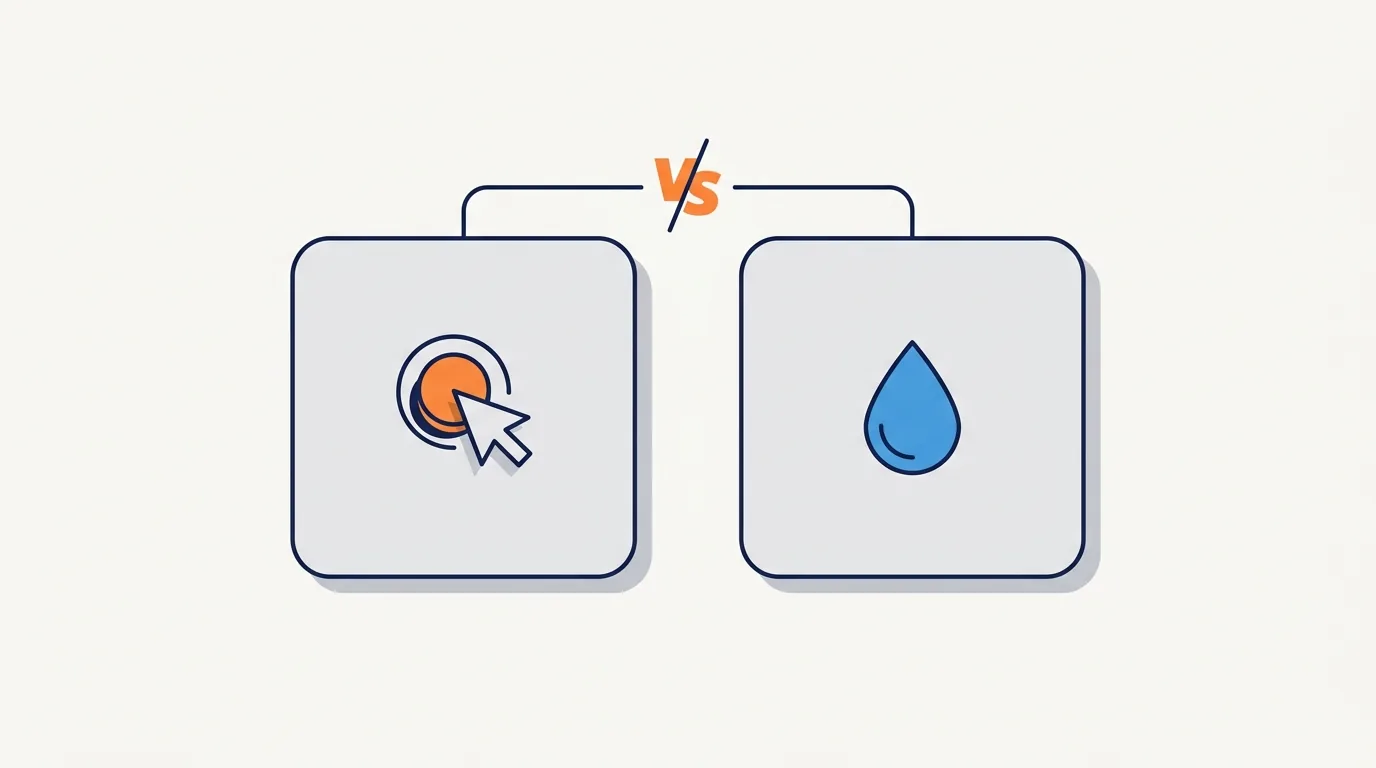
Earnings per action compared
Here is where the two models separate cleanly. The table below compares them on the dimensions that determine what you actually take home.
| Factor | Crypto faucets | PTC sites |
|---|---|---|
| Typical reward per action | Fractions of a cent | $0.02–$0.13 |
| Action required | Captcha, timer, ad page | View an ad for 10–15 seconds |
| Rate transparency | Often obscured | Rate shown before clicking |
| Cooldown per claim | Common (minutes to an hour) | Limited only by available ads |
| Extra earning paths | Rare | Offers, surveys, tasks |
| Effective rate per minute | Very low | Roughly up to ~$0.20 |
The striking difference is not the headline reward but the transparency and the absence of artificial throttling. On a PTC site you know what a task pays before you commit to it, and the only constraint is how many ads are available. On a faucet you are paid an amount you often cannot see in advance, and you are then blocked from earning again for a fixed interval. One model respects your time; the other rations it.
The extra earning paths matter more than they first appear. A faucet is a single narrow activity, so its ceiling is fixed and low. A PTC platform that also offers surveys, offers and short tasks gives you several ways to earn in the same session, which is how users reach totals that a faucet cannot approach. If you want to understand how those additional activities behave, our guide to PTC tasks versus offerwalls covers the trade-offs.
Payout thresholds and speed
Reward per action is only half the story; the other half is how long it takes to reach a withdrawal and how long the payment then takes to arrive.
| Metric | Crypto faucets | PTC sites |
|---|---|---|
| Typical minimum withdrawal | Often high, or gated behind offers | Low ($1–$2) |
| Time to reach minimum | Weeks to months | Days |
| Processing speed | Varies, often slow | Minutes to hours (crypto) |
| Withdrawal conditions | Sometimes requires deposits or referrals | Straightforward |
This is the dimension on which faucets most often fail their users. Because each claim is worth so little, the minimum withdrawal threshold — even when it looks modest in absolute terms — can represent weeks of daily claiming. Some faucets compound the problem by raising the requirement, or by making withdrawal conditional on completing a set number of offers or referring a certain number of users.
That last pattern deserves special attention. Any earning site that makes your ability to withdraw depend on recruiting other people, or on depositing your own money, is exhibiting the classic structure of a scheme rather than a legitimate payout model. PTC platforms with low minimums and transparent terms do not do this, and that difference alone makes them the more trustworthy category.
The test that settles it
Ask a simple question of either type of site: can a user who never spends a cent and never refers anyone receive a payout? On a legitimate PTC site with a low minimum, the answer is yes, within days. On a faucet that gates withdrawal behind deposits or referrals, the answer is no — and that tells you what the site is actually for.
Time investment and realistic returns
Putting a number on this makes the comparison concrete. A casual PTC user clicking for a few minutes a day earns roughly one to three dollars a month; someone maintaining a light daily habit across two or three platforms might reach ten to thirty dollars, and a committed user who adds offers and surveys can reach fifty to a hundred and twenty. Those figures are modest, and we present them honestly because inflated expectations are the most common way people end up disappointed in this category.
Now apply the same time to a faucet. The structural limits — fractions of a cent per claim and a forced cooldown — mean a faucet user earns a small fraction of even the casual PTC figure for comparable attention. There is no configuration, no platform choice and no technique that fixes this, because the constraint is built into the model rather than into your effort. A faucet is not a slow version of PTC; it is a different, lower-ceiling design.
Where a faucet can occasionally make sense is as a curiosity or as a way to acquire a tiny amount of a specific coin. If your actual goal is to hold a small quantity of a particular cryptocurrency and you do not want to buy it, a trustworthy faucet is one route — slow, but free. Framed that way, it is a hobby rather than an earning strategy, and it is honest to call it that.
Which is safer?
Neither category is intrinsically safe, but their failure modes differ in ways worth understanding.

Faucet-specific risks. The advertising-heavy design of faucets means you are frequently clicking through to third-party pages, some of which are low quality or outright malicious. Phishing attempts dressed as faucet "bonus" pages are common, and any faucet that asks you to connect a wallet with meaningful funds to claim a fraction of a cent is asking you to take a wildly disproportionate risk. The math is absurd when you state it plainly: never risk real funds for a claim worth less than a cent.
PTC-specific risks. The main hazards are platforms that require a deposit before withdrawal, platforms that inflate rates to attract signups and then restrict payouts, and "investment PTC" models that promise returns in exchange for capital. All three are variations on the same theme, and the defence is the same rule: a legitimate PTC site pays you for attention, never for money.
The rule that covers both categories
No legitimate earning site of any kind requires you to pay before you can be paid. If a faucet or PTC platform demands a deposit, an activation fee or a "verification" payment before withdrawal, it is a scam, whatever it calls itself. Regulators describe these structures consistently; the SEC's investor education pages on advance-fee and Ponzi schemes are a useful plain-language reference. See also our guide on how to spot a scam PTC site.
On balance, PTC sites with low minimums and transparent rates present a clearer and more contained risk profile, mainly because the terms are visible before you commit and the reward for each action is disclosed. Faucets ask you to click through to unfamiliar third-party pages repeatedly, which widens your exposure to low-quality advertising without improving your return.
Verdict: which should you use?
The honest answer, taking both models at face value, is that PTC sites are the better use of time for almost everyone. They pay more per action, they disclose their rates, they do not throttle you with artificial cooldowns, their minimums are lower, and they offer additional earning paths that raise the ceiling. A faucet is a lower-ceiling design with more friction and more exposure to dubious advertising, and no amount of optimisation changes that.
That said, the comparison is not quite faucets versus PTC in the abstract — it is about what each one is for. If you want to earn a small amount of spendable crypto with a clear, predictable process, use a PTC platform with low minimums and a payout method you trust. If you are curious about a particular coin and want a few units for free, a reputable faucet is a harmless hobby. What you should not do is treat a faucet as your main earning strategy, because the model will not support it.
If you are choosing a PTC platform to start with, our best PTC sites of 2026 guide ranks the options by rates and minimums, our comparison of PTC payment methods explains how to get paid, and our how to start earning on PTC sites walkthrough covers the first steps in order. For the crypto-specific angle, see our best PTC sites for crypto payouts guide.
The honest summary: faucets and PTC sites sit in the same neighbourhood but not the same league. Faucets are free, slow and structurally capped; PTC platforms pay a defined rate for a defined action and let you withdraw within days. Treat the first as a curiosity and the second as the practical option.
Frequently Asked Questions
Which pays more, PTC sites or crypto faucets?
PTC sites, by a wide margin. A faucet typically pays fractions of a cent per claim and forces a cooldown of minutes to an hour between claims, which caps what you can earn regardless of effort. A PTC site pays a defined reward of roughly two to thirteen cents per ad viewed, does not impose artificial cooldowns, and often offers additional earning paths such as offers and surveys, which is how users reach meaningfully higher totals.
Are crypto faucets still worth using in 2026?
As an earning strategy, no. The per-claim reward is a fraction of a cent and the cooldown structure limits your return no matter how much time you invest, so a faucet is not a slow version of PTC but a lower-ceiling design. As a curiosity, a reputable faucet is a harmless way to acquire a tiny amount of a specific coin for free, and it is honest to treat it as a hobby rather than income.
Are crypto faucets safe?
Their main risk comes from advertising. Faucets are ad-funded, so you click through to unfamiliar third-party pages repeatedly, which widens your exposure to low-quality or outright malicious sites, and phishing pages disguised as faucet bonuses are common. Never connect a wallet holding meaningful funds to claim a fraction of a cent — the risk is wildly disproportionate to the reward.
Why do faucets have withdrawal minimums that take so long to reach?
Because each claim is worth fractions of a cent, even a modest minimum withdrawal can represent weeks of daily claiming. Some faucets compound this by raising the requirement or by making withdrawal conditional on completing offers or referring users. Any site that makes your payout depend on depositing money or recruiting others is showing the structure of a scheme, not a legitimate payout model.
Can I use both PTC sites and faucets?
Yes, and some people do. The sensible arrangement is to make a PTC platform your main activity, since it pays more per action and lets you withdraw within days, and to treat a faucet as an occasional curiosity if you happen to want a small amount of a particular coin. What you should not do is rely on faucets as your primary earning method, because the model cannot support it.
CatPTC partner plans carry capital at risk, and a published return is not a guarantee of future performance. Task earning involves no deposit and therefore no capital at risk. Earnings depend on the tasks you complete. Nothing in this article is financial advice.
See what each CatPTC task pays before you click
Every task shows its reward and timer up front — plus a $1.50 signup bonus to start with.
Create your free account →Registration takes under a minute and needs no card.

The CatPTC editorial team researches paid-to-click platforms hands-on — verifying payout terms, withdrawal records and trust signals before publishing. Every guide is fact-checked against live platform data and updated whenever terms change.