Turkey sits in an awkward spot in the paid-to-click world. It has one of the largest and most digitally engaged populations in the region, a young workforce comfortable with mobile apps, and a long tradition of small side-earning online. Yet most of the English-language guides that rank for "best PTC sites" treat Turkey as an afterthought, and the Turkish-language content that does exist is overwhelmingly affiliate marketing written to earn a sign-up commission rather than to help you choose well.
That gap is what this guide fills. It covers how paid-to-click actually works for a user in Turkey in 2026, which platform types are worth your time, how Turkish earners get their money out once they have earned it, what a realistic monthly figure looks like, and the specific scam patterns that circulate in the Turkish market. It does not pretend that clicking ads is a job, and it does not recommend brands for the sake of a commission.
For users in Turkey, the best PTC sites are ones with a low payout minimum and a payout rail that survives the trip into Turkish lira — which in practice means crypto (USDT on a low-fee network) rather than the legacy processors most old platforms still use. Turkey's currency volatility makes the stability of a stablecoin genuinely useful, and local crypto exchange infrastructure is well developed, so converting to TRY is straightforward. The main risk is the large volume of offshore "investment PTC" schemes that target Turkish users with guaranteed-return promises.
PTC earning in Turkey: the basics
Start with the honest rate, because everything else follows from it. Across the paid-to-click category worldwide, an individual task typically pays somewhere between two and thirteen US cents for ten to fifteen seconds of attention, and the effective return per minute of genuine work rarely climbs above about twenty cents. That ceiling is a function of the advertising market, not of your effort or your country. No platform in Turkey, or anywhere else, has escaped it.
What makes Turkey distinctive is how much the receiving end matters. The lira has been volatile for years, and that single fact changes the arithmetic of small online earnings in two directions. On the debit side, it makes any earnings you leave sitting in lira lose purchasing power while you wait. On the credit side, it makes a dollar-denominated payout genuinely valuable as a store of value — a small USDT balance does not quietly erode the way an idle TRY balance can.
There is also a practical infrastructure advantage. Turkey has one of the most active crypto markets in the region, with well-established local exchanges that support TRY deposits and withdrawals, and a population that is comfortable moving between crypto and local currency. That means the conversion step that is a genuine obstacle for users in some countries is, for a Turkish user, a routine operation that takes minutes.
The trade-off is language and trust. A great deal of Turkish-language PTC content is written to funnel readers into a referral link, and much of it repeats claims that are simply not true — that a particular site pays "thousands of lira per day", or that a small deposit unlocks a monthly return. This guide takes the opposite position: fewer brand endorsements, more on how to tell a platform worth joining from one that is not.
Top reliable PTC sites for Turkish users
Brand names in this category change from quarter to quarter, so the durable approach is to understand the platform types available and the qualities that make one suitable for a Turkish user specifically. The table below sets out the categories you will encounter.
| Platform type | Payout rail | Typical minimum | Best for |
|---|---|---|---|
| Modern PTC (crypto-first) | USDT, BTC, low-fee coins | Low ($1–$2) | Fast small withdrawals, stable value |
| GPT / survey platforms | Crypto, gift cards | $5–$10 | Higher reward per task, where surveys are available |
| Offer-wall platforms | Crypto, some e-wallets | Low | Users who would rather complete offers than click |
| Legacy PTC | Often restricted or TRY-unfriendly | Varies, usually high | Not recommended in 2026 |
For most Turkish users, a modern crypto-first platform is the correct starting point, and the reasoning is more specific than "crypto is trendy". A crypto payout is the only rail that both works reliably from an offshore platform and lets you hold value in something other than lira while you decide what to do with it. A platform that pays in USDT on the TRC20 network is, in effect, paying you in a currency that both resists local volatility and converts cheaply on a Turkish exchange.
GPT and survey platforms deserve real consideration if you want more per task, but set your expectations carefully. Global survey panels need Turkish respondents, and demand fluctuates by month and by demographic. Some weeks you will qualify for several studies; other weeks almost none. Treat surveys as a supplement to clicking, never as a replacement, and never build a monthly budget on survey income.
Legacy PTC brands are, as in every market, best avoided. The oldest platforms survive on brand recognition, and their per-click rates have been quietly diluted for years while their withdrawal terms have tightened and their minimums have risen. A platform that advertises its longevity rather than its current rates is telling you something about where its value went. For a technical breakdown of how the rails compare on fees, minimums and speed, see our guide to PTC payment methods compared.
Payment methods and TRY withdrawals
This is where Turkey differs most from the generic advice you will read elsewhere, and understanding the route matters more than the platform you pick.
| Method | Availability | Cost to receive | Speed | Verdict |
|---|---|---|---|---|
| USDT (TRC20) | Widely supported | Very low | Minutes | Best default for small payouts |
| Bitcoin | Widely supported | High on small amounts | Minutes to hours | Only for larger sums |
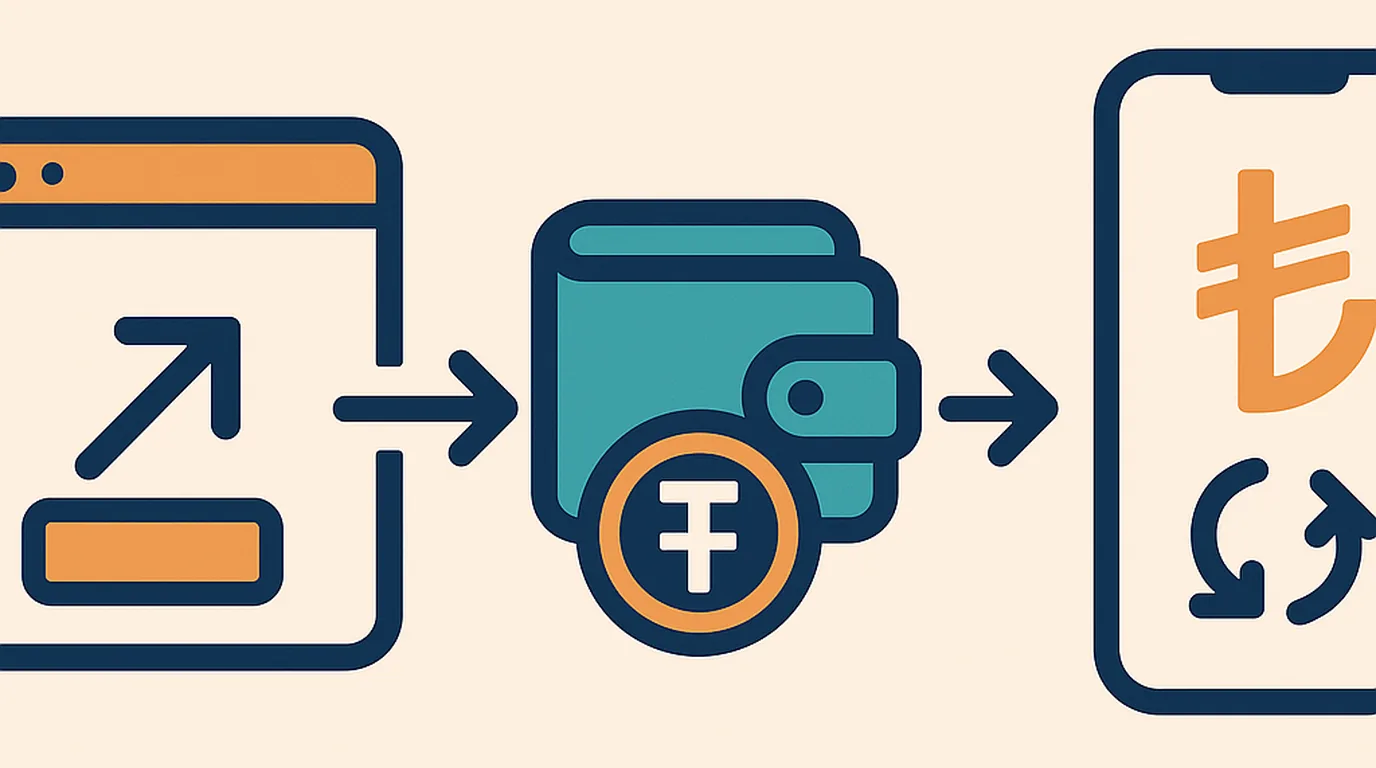
| Crypto → local TRY exchange | Works well | Low (small spread) | Under an hour | The practical standard route |
| International e-wallets | Patchy availability | Moderate | Hours to days | Check availability before relying on it |
| Gift cards | Some platforms | None | Minutes | Fine for specific retailers |
USDT on the TRC20 network is the correct default for small withdrawals, and for Turkish users there is an extra reason beyond low fees. A stablecoin lets you hold the dollar value of your earnings for as long as you like without the sum drifting. If you are earning a few dollars a month, that stability is not a theoretical nicety — it is the difference between a payout that keeps its worth and one that does not.
Bitcoin is a poor choice for small amounts. Network fees can exceed the value of a two-dollar payout, which means you are effectively paying a large percentage of your earnings simply to receive it. Reserve Bitcoin for larger accumulated sums where the fee is a rounding error.
Watch the spread, not just the fee
The advertised fee on a crypto-to-TRY conversion is rarely the whole cost. Local exchanges typically earn on the spread between their buy and sell prices, and that spread is where most of your real cost hides. Compare the price you are offered against a public reference rate before converting, and if the gap is wide, try a different exchange — the difference on a small payout is often larger than the transaction fee itself.
International e-wallets, where they are offered at all, are worth checking before you commit to a platform, because availability in Turkey has been inconsistent. Do not assume that an e-wallet your platform advertises will actually work for a Turkish account; test it with a small amount before you build up a balance you want to withdraw.
Minimum payouts and speed
Minimum thresholds shape your real experience more than headline rates do, because they determine how long you wait before you can find out whether the platform pays at all.
| Platform type | Typical minimum | Processing time | Time to first payout |
|---|---|---|---|
| Modern PTC (crypto) | $1–$2 | Minutes to hours | Often under a week |
| GPT / survey | $5–$10 | Hours to 5 days | Two to four weeks |
| Offer-wall | Low | Hours to days | One to two weeks |
| Legacy PTC | Often high | Days to weeks | Weeks, or never |
The advice here is the same as anywhere, but it carries more weight in a market with a lot of scam activity: prioritise a low minimum and withdraw as soon as you possibly can. Your first payout is not really about the money. It is the only reliable test of whether the platform is real. Two dollars that arrives in twenty minutes tells you more than twenty dollars promised for next month.
Realistic monthly earnings
Here is the honest range, in US dollars because that is how platforms quote. A casual Turkish user clicking for a few minutes a day earns roughly one to three dollars a month. Someone keeping a light daily habit across two or three platforms might reach ten to thirty dollars. A committed user who adds offers, surveys and a small referral base can reach fifty to a hundred and twenty dollars — but at that point the activity has stopped being casual, and surveys usually make up the largest share of the total.
What drives the difference is not clicking skill or speed. It is the number of platforms and the variety of activities, because any single PTC site runs out of available tasks well before you run out of time. The ceiling on one platform is low by design. Widening across a small, maintained set is the only lever that exists before referrals.
Compare by rate per minute, not per click
A site paying five cents for a fifteen-second task beats one paying eight cents for a thirty-second task with a two-page ad to close. The only way to see that clearly is to convert every opportunity to a per-minute figure and refresh it weekly. Our guide to PTC earnings per click and hourly rate walks through the arithmetic step by step.
Note as well that earnings do not scale linearly with time. Clicking twice as long does not double your income, because available tasks run out. The one lever that scales without a matching increase in hours is referrals, which is why experienced earners in every market eventually build a small referral base. Our guide on how to get referrals on PTC sites explains the approaches that work and the ones that get you banned.
How to spot scams in the Turkish market
Turkey's large online-earning audience makes it a target, and the schemes that circulate in Turkish are worth knowing specifically because they are packaged to look local and trustworthy.

The first and most reliable test applies everywhere: a legitimate PTC site never asks you to pay in order to earn. If a platform requires a membership fee, an activation payment or a minimum deposit before you can withdraw, stop immediately. Some of these operations pay a small amount early to build confidence and then stop paying once your deposit has grown — a structure that is a textbook advance-fee or Ponzi scheme wearing paid-to-click language.
The one rule that protects you
A real PTC site pays you for attention, not for deposits. If money must flow from your account to theirs before you can be paid, it is not a PTC site, whatever it calls itself. For a full breakdown of the warning signs, see our guide on how to spot a scam PTC site.
Beyond the deposit demand, watch for four more patterns. Promises of a guaranteed daily return, which no advertising-funded platform can honestly make. Referral schemes where your ability to withdraw depends on recruiting other people, which means the money is coming from new members rather than from advertisers. Withdrawal thresholds that rise as you approach them. And "investment PTC" models where the pitch centres on returns rather than on tasks — these are the most dangerous variant in the Turkish market, and regulators worldwide describe their mechanics in consistent terms. The SEC's Investor.gov resources on Ponzi and advance-fee schemes are a plain-language reference worth reading even outside the United States. Before you invest real effort in any platform, check independent reviews on Trustpilot, and read the one-star reviews first.
Getting started
Doing this in the right order saves wasted effort and, more importantly, tells you quickly whether a platform is real.
- Join one platform only. Pick a modern PTC site with a low minimum and crypto payouts. Signing up for five at once splits your attention and delays the test that actually matters.
- Set up your receiving wallet on day one. Create a wallet that supports USDT on TRC20 and confirm you can receive to it. Do not wait until you hit the minimum to discover a problem.
- Register on a Turkish exchange that supports TRY. Set this up early so the conversion step is ready when your first payout lands, rather than being a hurdle afterwards.
- Click until you reach the minimum — usually a few days of light effort, not weeks.
- Withdraw and convert. Take the payout, move it through your exchange, and confirm the lira reaches your account. That end-to-end test is the entire point.
- Keep records as you go. Date, platform, amount and the TRY value at the time, in a simple spreadsheet. It costs seconds and saves a difficult reconstruction later.
- Only then add a second platform, and cap the total at what you can genuinely maintain each day.
For the full walkthrough, our guide to how to start earning on PTC sites covers the process in detail, and our beginner series maps the first seven days on a PTC platform. If you want to compare against the wider market, our ranking of the best PTC sites of 2026 is the reference point.
The honest summary: Turkey is a workable market for this kind of earning, not because the rates are higher — they are not — but because the receiving side is efficient and a dollar-denominated payout holds its value in a way that lira does not. Choose a platform on its minimum and its payout rail, test the withdrawal in your first week, keep your records, and treat the income as what it is: a small, accessible supplement rather than a job.
Frequently Asked Questions
Are PTC sites worth it in Turkey in 2026?
As a supplement, yes. Turkish users can withdraw through crypto rails that convert cheaply to lira on a local exchange, and a dollar-denominated payout holds its value in a way an idle lira balance does not. The amounts are modest — roughly $1 to $3 a month for casual clicking and $10 to $30 for a light daily habit across two or three platforms. PTC is not a wage and should never be treated as one.
What is the best way for Turkish users to get paid by a PTC site?
USDT on the TRC20 network is the best default, because fees are negligible and the value does not drift while you hold it. Bitcoin is a poor choice for small withdrawals since network fees can exceed the payout. Convert to TRY on a local exchange when you want cash, and check the exchange spread rather than just the advertised fee.
Do I have to pay tax on PTC earnings in Turkey?
Income earned online, including paid-to-click, can be taxable in Turkey and the rules have changed repeatedly in recent years, particularly around crypto. Keep a dated log of every payout with the amount and the TRY value at the time of receipt. If your earnings are more than trivial, speak to a Turkish tax advisor who follows the current rules.
How do I know if a PTC site is a scam?
The most reliable test is whether money has to flow from you to the platform before you can be paid. A legitimate PTC site pays you for attention; if it charges a membership or activation fee, or requires a minimum deposit before withdrawal, it is a scam. Other warnings are guaranteed daily returns, referral schemes where withdrawal depends on recruiting, and thresholds that rise as you approach them.
How long does a first PTC withdrawal take in Turkey?
On a modern PTC site with a $1 to $2 minimum and crypto payouts, a first withdrawal is often reachable in under a week and processes in minutes to hours. On GPT or survey platforms with a $5 to $10 minimum, expect two to four weeks to reach the threshold and one to five business days for processing.
CatPTC partner plans carry capital at risk, and a published return is not a guarantee of future performance. Task earning involves no deposit and therefore no capital at risk. Earnings depend on the tasks you complete. Nothing in this article is financial advice.
See what each CatPTC task pays before you click
Every task shows its reward and timer up front — plus a $1.50 signup bonus to get started.
Create your free account →Registration takes under a minute and needs no card.

The CatPTC editorial team researches paid-to-click platforms hands-on — verifying payout terms, withdrawal records and trust signals before publishing. Every guide is fact-checked against live platform data and updated whenever terms change.