
Vietnam has quietly become one of the most interesting markets in the world for anyone who earns small amounts of money online. It has a young population, near-universal smartphone adoption, extremely high levels of cryptocurrency ownership relative to its income level, and a generation that treats earning a few dollars a week from a phone as entirely normal. Chainalysis has repeatedly ranked Vietnam among the highest countries globally for grassroots crypto adoption, and that is not an accident — it reflects a population that has learned to move money digitally long before the traditional banking system caught up.
Yet almost none of the English-language guides to paid-to-click say anything useful about Vietnam. They lump it into generic "Asia" advice or ignore it entirely, and the Vietnamese-language content that exists is mostly affiliate copy written around a referral link. This guide covers what actually works for a Vietnamese user in 2026: which platform types are worth joining, how money gets from a PTC platform into a Vietnamese bank account or e-wallet, what a realistic monthly figure looks like, and the scam patterns that specifically target this market.
For users in Vietnam, the best PTC sites are ones with a low payout minimum and crypto withdrawals, because crypto is the rail that both works from offshore platforms and converts efficiently into Vietnamese dong. Vietnam's deep crypto familiarity makes that conversion routine rather than intimidating. E-wallets such as MoMo and ZaloPay are excellent for receiving money domestically, but direct PTC payouts into them are rare, so the practical route is crypto first, then convert. The main risk is the volume of small offshore schemes that target Vietnamese users with deposit-for-return promises.
PTC earning in Vietnam: what works
Begin with the honest number, because every other decision depends on it. A single paid-to-click task almost always pays between two and thirteen US cents for ten to fifteen seconds of attention, and the effective return per minute of real work sits somewhere under twenty cents. That is a global characteristic of the advertising market, not a limitation specific to Vietnam. Any platform that implies Vietnamese users can earn dramatically more is selling a sign-up, not a job.
What genuinely works in Vietnam is the combination of a low entry barrier and a receiving system that is now very efficient. The Vietnamese dong is a closed currency, which historically made small international payouts awkward. Crypto changed that. A Vietnamese user can receive USDT from an offshore platform into a personal wallet and convert it to dong on a local exchange, often within the same hour and at low cost. The conversion is no longer the hard part; the number of platforms worth your time is.
There is a second factor that matters more in Vietnam than in many markets: familiarity. Vietnamese users are statistically more likely to already hold crypto, to understand wallets and network fees, and to be comfortable with the idea of a token rather than a bank transfer. That removes most of the friction that stops beginners in other countries, which means a Vietnamese user can reach a working, tested withdrawal faster than someone who has never touched a wallet.
The trade-off is that the market attracts opportunists. Vietnam's high engagement with online earning makes it a target for schemes that dress themselves in local language and local appeals. A disproportionate share of the "earn online" content aimed at Vietnamese readers exists to collect a commission, so the ability to tell a real platform from a bad one is more valuable here than it is almost anywhere else.
Best PTC sites for Vietnamese users 2026
Specific brand names in this category shift constantly, so the durable approach is to understand the platform types and the qualities that suit a Vietnamese user in particular. The table below sets out the categories you will meet.
| Platform type | Payout rail | Typical minimum | Best for |
|---|---|---|---|
| Modern PTC (crypto-first) | USDT, BTC, low-fee coins | Low ($1–$2) | Fast small withdrawals, easy dong conversion |
| GPT / survey platforms | Crypto, gift cards | $5–$10 | Higher reward per task where surveys are open |
| Offer-wall platforms | Crypto | Low | Users who prefer offers to clicking |
| Legacy PTC | Often restricted for VN users | Varies, usually high | Not recommended in 2026 |
For most Vietnamese users, a modern crypto-first PTC platform is the right place to begin. The reason is not that crypto is fashionable but that it is the only payout rail that reliably leaves an offshore platform and can be turned into dong cheaply and quickly. A platform paying USDT on a low-fee network is, in practice, paying you in something that a local exchange will convert the same day.
GPT and survey platforms are worth a look if you want more per task, but be realistic. Global panels need Vietnamese respondents, and demand varies a great deal by month, age and demographic. Some weeks you will qualify for several studies; other weeks you will be screened out repeatedly. Treat surveys as a top-up on clicking, never as the foundation of a monthly target.
Legacy PTC brands are best avoided, for the same reason as everywhere else. The oldest sites survive on name recognition while quietly diluting their click rates and tightening withdrawal terms. Some of them also restrict or complicate access from Vietnam. A platform that markets its age rather than its current rates is telling you where its value went. For a technical comparison of how the rails differ on fees, minimums and speed, see our guide to PTC payment methods compared.
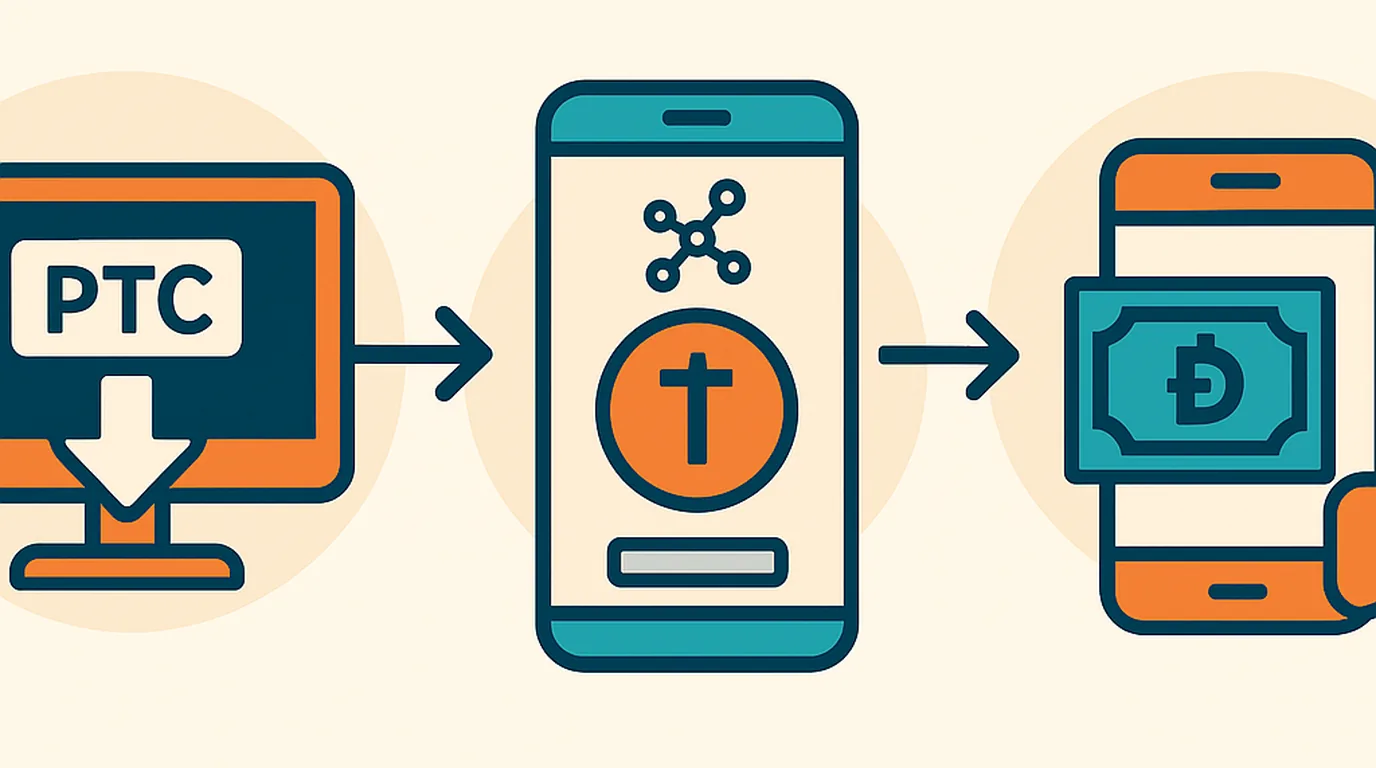
Payout methods: bank, crypto and e-wallets
This is where Vietnam differs most from generic advice, and the route matters more than the platform you choose.
| Method | Availability | Cost to receive | Speed | Verdict |
|---|---|---|---|---|
| USDT (TRC20) | Widely supported | Very low | Minutes | Best default for small payouts |
| Bitcoin | Widely supported | High on small amounts | Minutes to hours | Only for larger sums |
| Crypto → local exchange → VND | Works well | Low (small spread) | Under an hour | The practical standard route |
| E-wallets (MoMo, ZaloPay) | Rarely direct from PTC platforms | Low | Instant | Great for domestic use, not a PTC rail |
| Bank transfer | Rarely direct | Moderate | Hours to days | Use after converting locally |
USDT on the TRC20 network is the correct default for small withdrawals. It is a stablecoin, so its value does not move while you hold it, and TRC20 fees are negligible — which matters enormously when the payout is two dollars. A local exchange then converts it to dong at a small spread, and the money can be moved into your bank account or an e-wallet like MoMo or ZaloPay immediately afterwards.
Bitcoin is a poor choice for small amounts. On a two-dollar withdrawal, network fees can consume a large fraction of the payout. Reserve Bitcoin for larger accumulated sums where the fee becomes a rounding error rather than a tax on your earnings.
VND is a closed currency — plan the last mile
The Vietnamese dong is not freely convertible outside Vietnam, so the final step always happens locally. That is not a problem, but it does mean you should choose your local exchange before you start earning, not after. Confirm it supports deposits from the wallet you intend to use and that it pays out to your bank or e-wallet quickly. Sorting this out on day one turns a first payout into a fifteen-minute task instead of a week-long puzzle.
Some newer platforms advertise direct e-wallet or even direct bank payouts for Vietnamese users. Treat those claims cautiously until the platform has actually paid you, because delivering to MoMo or ZaloPay requires a licensed local partner and most genuinely offshore operators do not have one. Test any platform with a small withdrawal before building a balance you care about.
Minimum payouts and processing times
Minimum thresholds shape your real experience more than headline rates do, because they decide how long you wait before you can find out whether a platform pays at all.
| Platform type | Typical minimum | Processing time | Time to first payout |
|---|---|---|---|
| Modern PTC (crypto) | $1–$2 | Minutes to hours | Often under a week |
| GPT / survey | $5–$10 | Hours to 5 days | Two to four weeks |
| Offer-wall | Low | Hours to days | One to two weeks |
| Legacy PTC | Often high | Days to weeks | Weeks, or never |
The advice is the same as anywhere but matters more in a market with active scams: prioritise a low minimum and withdraw at the first opportunity. Your first payout is not about the money. It is the only reliable test of whether the platform is genuine. A two-dollar payment arriving in twenty minutes proves more than a twenty-dollar promise that never clears.
How much you can earn
Here is the honest range in US dollars, because that is how platforms quote. A casual Vietnamese user clicking a few minutes a day earns roughly one to three dollars a month. Someone maintaining a light daily habit across two or three platforms might reach ten to thirty dollars. A committed user who adds offers, surveys and a small referral network can reach fifty to a hundred and twenty dollars — but by then the activity has stopped being casual, and surveys usually dominate the total.
What drives the difference is not speed or skill. It is the number of platforms and the variety of activities, because a single site runs out of available tasks long before you run out of time. In Vietnam, where the same dollar buys more, a modest monthly figure like ten to thirty dollars is a more meaningful supplement than it would be in a higher-cost country, which is part of why this kind of earning is so widely adopted here.
Compare by rate per minute, not per click
A site paying five cents for a fifteen-second task beats one paying eight cents for a thirty-second task with a two-page ad to close. Convert every opportunity to a per-minute figure and refresh it weekly. Our guide to PTC earnings per click and hourly rate walks through the arithmetic.
Earnings also do not scale linearly with time. Clicking twice as long does not double your income, because tasks run out. The one lever that scales without a matching increase in hours is referrals, which is why experienced earners everywhere build a small referral base. Our guide on how to get referrals on PTC sites covers the methods that work and the ones that get accounts restricted.
Avoiding scams in the Vietnamese market
Vietnam's large and engaged online-earning audience makes it a target, and the schemes that circulate in Vietnamese are worth knowing because they are packaged to look local and credible.

The first and most reliable test is universal: a legitimate PTC site never asks you to pay in order to earn. If a platform requires a membership fee, an activation payment or a minimum deposit before you can withdraw, stop. Some of these operations pay a small amount early to build trust and then stop paying once your deposit has grown — the classic structure of an advance-fee or Ponzi scheme wearing paid-to-click language. In Vietnam these often appear as "investment" platforms promising a fixed daily profit, which is the most dangerous variant precisely because the early payments feel real.
The one rule that protects you
A real PTC site pays you for attention, not for deposits. If money must flow from your account to theirs before you can be paid, it is not a PTC site, whatever it calls itself. For a full breakdown of the warning signs, see our guide on how to spot a scam PTC site.
Beyond the deposit demand, watch for four more patterns: promises of a guaranteed daily return, referral structures where your ability to withdraw depends on recruiting others, withdrawal thresholds that rise as you approach them, and platforms that communicate only through chat apps and never through a verifiable company presence. Regulators worldwide describe these mechanics in consistent terms, and the SEC's Investor.gov resources on Ponzi and advance-fee schemes are a useful plain-language reference even outside the United States. Before committing effort to any platform, check independent reviews on Trustpilot, and read the one-star reviews first.
Start earning: step by step
Doing this in the right order saves wasted effort and, more importantly, tells you quickly whether a platform is real.
- Join one platform only. Pick a modern PTC site with a low minimum and crypto payouts. Signing up for five at once splits your attention and delays the test that matters.
- Set up your receiving wallet on day one. Create a wallet that supports USDT on TRC20 and confirm you can receive to it before you earn anything.
- Register on a local exchange that supports VND. Sort this out early so the conversion step is ready when your first payout lands.
- Click until you reach the minimum — usually a few days of light effort, not weeks.
- Withdraw and convert. Take the payout, move it through your exchange, and confirm the dong reaches your bank or e-wallet. That end-to-end test is the whole point.
- Keep records as you go. Date, platform, amount and the VND value at the time, in a simple spreadsheet.
- Only then add a second platform, and cap the total at what you can genuinely maintain.
For the full walkthrough, our guide to how to start earning on PTC sites covers the process in detail, and our beginner series maps the first seven days on a PTC platform. For a regional comparison, see our guide to the best PTC sites in Indonesia, and for the wider market, the best PTC sites of 2026.
The honest summary: Vietnam is one of the better markets in the world for this kind of earning, not because the rates are higher — they are not — but because the population is already fluent in crypto, the conversion to dong is cheap and fast, and a small dollar income goes further here. Choose a platform on its minimum and its payout rail, test the withdrawal in your first week, keep your records, and treat the income as a small, accessible supplement rather than a job.
Frequently Asked Questions
Are PTC sites worth it in Vietnam in 2026?
As a supplement, yes. Vietnamese users can withdraw through crypto rails that convert cheaply to dong on a local exchange, and the population is already comfortable with wallets and tokens, so a first tested withdrawal is reachable quickly. The amounts are modest — roughly $1 to $3 a month for casual clicking and $10 to $30 for a light daily habit across two or three platforms — but in Vietnam a small dollar income goes further than in higher-cost countries.
What is the best way for Vietnamese users to get paid by a PTC site?
USDT on the TRC20 network is the best default, because fees are negligible and the value does not drift while you hold it. Bitcoin is a poor choice for small withdrawals since network fees can exceed the payout. Convert to dong on a local exchange when you want cash, and compare the exchange spread rather than only the advertised fee.
Can I get paid directly to MoMo or ZaloPay by a PTC site?
Direct e-wallet payouts from PTC platforms are rare, because delivering to MoMo or ZaloPay requires a licensed local partner and most genuinely offshore operators do not have one. The practical route is to receive crypto, convert it on a local exchange, and then move the dong into your e-wallet or bank account, which takes minutes.
How do I know if a PTC site is a scam?
The most reliable test is whether money has to flow from you to the platform before you can be paid. A legitimate PTC site pays you for attention; if it charges a membership or activation fee, or requires a minimum deposit before withdrawal, it is a scam. Other warnings are guaranteed daily returns, referral schemes where withdrawal depends on recruiting, and thresholds that rise as you approach them.
How long does a first PTC withdrawal take in Vietnam?
On a modern PTC site with a $1 to $2 minimum and crypto payouts, a first withdrawal is often reachable in under a week and processes in minutes to hours. On GPT or survey platforms with a $5 to $10 minimum, expect two to four weeks to reach the threshold and one to five business days for processing.
CatPTC partner plans carry capital at risk, and a published return is not a guarantee of future performance. Task earning involves no deposit and therefore no capital at risk. Earnings depend on the tasks you complete. Nothing in this article is financial advice.
See what each CatPTC task pays before you click
Every task shows its reward and timer up front — plus a $1.50 signup bonus to start with.
Create your free account →Registration takes under a minute and needs no card.

The CatPTC editorial team researches paid-to-click platforms hands-on — verifying payout terms, withdrawal records and trust signals before publishing. Every guide is fact-checked against live platform data and updated whenever terms change.