
Paid-to-click has a vocabulary problem. Its community writes in abbreviations, its platforms invent terms for ordinary things, and its forums assume you already know what a rented referral is before you can ask a question about one. A newcomer reading a PTC discussion for the first time meets a wall of shorthand — PTC, GPT, offerwall, downline, cashout, threshold — and reasonably concludes that the whole thing is more complicated than it is.
It is not. Underneath the jargon, PTC is one of the simplest earning models online: you are paid a small amount for viewing an advertisement. Everything else is elaborate naming for a handful of basic ideas. This glossary defines every term you will meet, in plain language, organised by category so you can find what you need without reading the whole thing. Each entry explains not just what a word means but why it matters to your money.
The terms that matter most to a beginner are PTC (paid-to-click, being paid to view ads), GPT (get-paid-to, the wider umbrella that includes surveys and offers), offerwall (a page of tasks and app trials), referral (someone who signs up through your link and earns you commission), rented referral (a user you lease from the platform for a recurring fee), minimum or threshold (the balance you must reach before withdrawing), and cashout (the act of withdrawing). Learn those seven and the rest of the vocabulary will make sense as you encounter it.
Core PTC terms
These are the words that describe the model itself. If you understand this section, you understand what a PTC site fundamentally is.
PTC (Paid-to-Click). A platform that pays members a small amount to view an advertisement for a set number of seconds. The advertiser pays the platform, and the platform passes a fraction of that payment to you. A typical task rewards between two and thirteen US cents for ten to fifteen seconds of attention. Everything else in the model is built on this one transaction.
PTC site. The platform itself — sometimes an independent company, sometimes part of a larger ad network. Not all PTC sites are equal: their rates, task inventories, payout minimums and payment rails vary enormously, which is why choosing well matters more than clicking fast.
GPT (Get-Paid-To). The wider category that includes PTC but is not limited to it. A GPT platform pays for a broader range of activities — surveys, app trials, product tests, watching videos and completing offers — of which clicking ads is only one. GPT platforms usually pay more per task than pure PTC sites, because survey and offer work is worth more to the advertiser, but the tasks are less reliably available. For the difference in detail, see our guide to PTC sites vs GPT sites.
PTSU (Paid-to-Sign-Up). A task where you are paid for registering with a third-party service through the platform's link. Usually worth more than a click, but it hands your email address to another company, so read the terms before you trade your inbox for a few cents.
Offerwall. A page, often supplied by a third-party provider, listing offers, app installs, trials and tasks for varying rewards. Offerwalls generally pay better per minute than clicking because completion is worth more to the advertiser, but they demand more attention and the completion criteria can be strict. Our breakdown of PTC tasks vs offerwalls covers the trade-off.
Referral terms
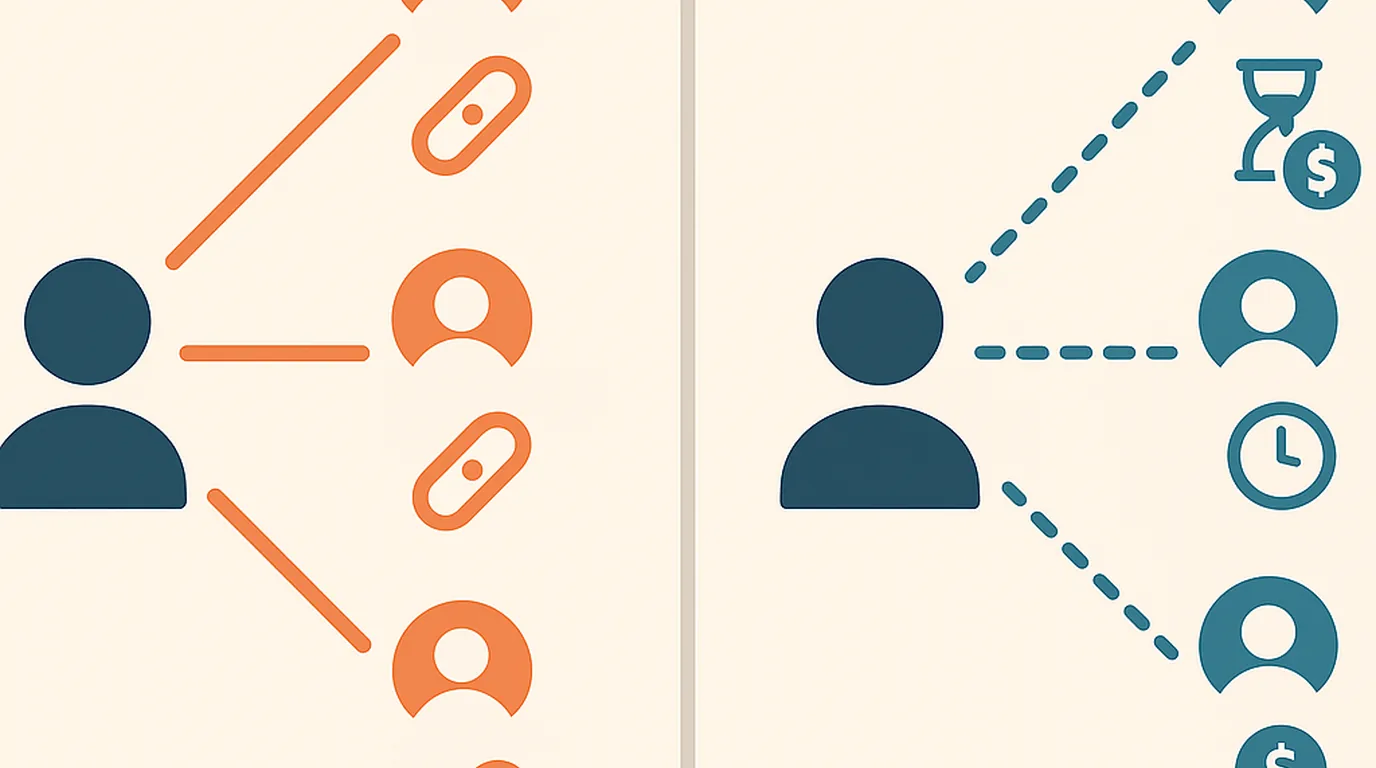
Referral vocabulary causes more confusion than any other part of PTC, largely because the same word is used for two entirely different arrangements.
Referral. A user who signs up to a platform through your unique link. Once attributed to you, they generate a commission for you whenever they earn on the platform. There is nothing to pay and nothing to renew — the relationship simply exists.
Direct referral. A referral you recruited personally, through a friend, an article, a video, a forum answer or any other channel. Direct referrals cost you effort rather than money and, crucially, they are permanent: a direct referral you recruited three years ago is still yours today, and still earning you commission if they remain active. This durability is why direct referrals are the foundation of any serious long-term plan.
Rented referral. A user the platform leases to you for a recurring fee, usually monthly or on a renewal cycle. Rented referrals let you acquire a working referral base in minutes instead of months — but each one has a break-even point, the commission it must generate to cover its own rent, and a portion of any batch will be inactive. Without tracking, renting is a slow way to lose money. Our explainer on PTC rented referrals takes apart the arithmetic, and our comparison of direct vs rented referrals covers which to build.
Downline. Your entire network of referrals, whether recruited or rented, considered as a group. A "two-level downline" exists when your referrals also recruit referrals and you earn a smaller commission on that second tier as well.
Upline. The person whose referral link you signed up under. If you joined through someone's recommendation, they are your upline and they earn commission on your activity.
Referral commission. The percentage of a referral's earnings that is credited to you. It typically ranges from ten to fifty per cent depending on the platform and your membership level, and it is very often the same percentage for direct and rented referrals — which is precisely why the cheaper of the two is the better deal per unit of commission.
Earning terms
These are the words that describe how money actually accrues on a platform, and getting them right is what separates accurate comparison from guesswork.
Per-click rate. The advertised reward for viewing one advertisement. It is the most quoted figure in PTC and the least useful on its own, because it says nothing about how long the task takes or how much friction surrounds it. A high per-click rate attached to a slow, multi-step task can be worth less than a low rate on a clean, quick one.
Effective rate. What a task is actually worth once you account for the real time it consumes, including the timer, any captcha, any follow-on page and the navigation between tasks. Expressed per minute or per hour, it is the only figure that lets you compare two platforms fairly. Our guide to PTC earnings per click and hourly rate shows how to work it out.
Ad credits. Some platforms let you spend part of your balance on advertising your own referral link in exchange for credits or earnings. It sounds circular, and it partly is — but a well-run ad credit scheme can be a genuinely cheap way to attract direct referrals, provided you track what it returns.
Daily bonus. A small reward for logging in, and often additional bonuses for maintaining a streak of consecutive days or for completing a set number of tasks. Individually worth cents, collectively worth twenty to forty per cent of a casual user's monthly total — which makes them the highest-value two minutes on most platforms.
Level or membership tier. A rating that unlocks higher rates, more tasks or better referral commissions as you meet thresholds of activity or spend. Some tiers are earned through activity and are free; others require payment and demand caution. The dividing line is whether the platform asks you for money before it will release your own earnings.
Task timer. The countdown that must elapse before a click counts as complete. You are being paid for verified attention, so the timer is the proof. Closing the window early forfeits the reward, and repeatedly doing so can flag your account.
Payout terms
Payout vocabulary governs the step where most beginner frustration lives, because it decides when a balance becomes money.
Minimum payout / minimum withdrawal. The balance you must reach before you can request a withdrawal. It is arguably the single most important number on any platform, because a low minimum lets you test whether the site pays quickly, while a high one leaves your balance exposed on an unverified platform for weeks. A platform with a low minimum and a working payout rail can be validated in days; one with a high minimum and an obscure processor may never be validated at all.
Threshold. A synonym for minimum payout, used slightly differently — often referring to the requirement to reach a minimum before a bonus or a particular method becomes available.
Cashout. The act of withdrawing your balance. On a modern platform with crypto payouts, a cashout is usually initiated in a few clicks and completes within minutes to hours.
Payout rail / payment processor. The channel that actually moves money — a stablecoin transfer, a bank transfer, an e-wallet, a mobile-money network or an international processor. The rail matters as much as the platform: a listed method that does not work in your country is a payment you cannot collect, which is why testing with a small amount early is essential.
Processing time. How long a platform takes to approve and send a withdrawal after you request it. Fast platforms process within hours; slow ones batch requests weekly. Processing time is not the same as conversion time, which happens after the money has left the platform.
Hold. A temporary freeze a platform can apply to a balance pending verification or review. A short hold on a first withdrawal is normal; an indefinite hold with no explanation is a warning sign.
| Term | Plain meaning | Why it matters |
|---|---|---|
| Minimum payout | Balance required before you can withdraw | Decides how fast you can test the platform |
| Threshold | Same idea, often for a bonus or method | Unlocks extra value or a different rail |
| Cashout | Withdrawing your balance | The step that turns a promise into money |
| Payout rail | The channel money travels through | A rail that fails in your country is a loss |
| Processing time | Platform-side delay before sending | Determines how long your money is in limbo |
Safety terms
Finally, the vocabulary of risk. These words come up constantly in PTC discussions, and knowing them precisely is what lets you recognise a dangerous platform early.
Scam. A platform that intends to take money rather than pay it. In PTC the reliable test is whether money must flow from you to the platform before you can be paid. A legitimate PTC site pays you for attention; one that demands a membership fee, an activation payment or a deposit before withdrawal is not a PTC site, whatever it calls itself. Our guide on how to spot a scam PTC site lists the warning signs in detail.
Ponzi scheme. A structure that pays early participants using money from later ones rather than from real revenue, which collapses once recruitment slows. In PTC it appears as an "investment" platform promising a fixed daily return. The mechanics are described consistently by regulators worldwide, and the SEC's Investor.gov resources on Ponzi and advance-fee schemes are a plain-language reference worth reading even outside the United States.
Advance-fee scam. A scheme that asks you to pay a fee, tax or deposit in order to release money you are allegedly owed. In PTC this often appears as a "withdrawal fee" that must be paid before your balance is released — a guaranteed loss, because the balance is fictitious. Our guide to PTC ponzi schemes covers the variants.
Verification (KYC). Identity checks a platform may run before processing withdrawals, often a photo of an ID plus proof of address. Legitimate platforms do this to comply with financial rules, and a request for it is not itself a red flag — but no legitimate platform will ever ask for your password or a payment card PIN as part of it.
Chargeback / reversed payment. When a funder reverses a payment after the fact, often because a sign-up or offer was completed fraudulently by a third party. Platforms claw back the corresponding balance, which is why an unexplained sudden drop in your earnings is usually the platform passing on a reversal rather than an error.
The three safety terms worth memorising
Deposit-before-payout is the signature of a scam, because it inverts the model. Guaranteed daily return is the signature of a Ponzi scheme, because genuine advertising income cannot be guaranteed. Withdrawal fee is the signature of an advance-fee scam, because you should never pay to receive your own money. Spot any one of these and stop.
Quick-reference table
Everything above, condensed into one place. If you are reading a PTC discussion and hit a term you do not recognise, this table is the fastest way back to plain English.
| Term | Category | Meaning |
|---|---|---|
| PTC | Core | Paid-to-click; being paid to view ads |
| PTS / PTSU | Core | Paid-to-sign-up; paid for registering elsewhere |
| GPT | Core | Get-paid-to; the umbrella over PTC, surveys and offers |
| Offerwall | Core | A page of offers, trials and app installs for rewards |
| Direct referral | Referral | A person you recruited permanently, costing only effort |
| Rented referral | Referral | A user you lease for a recurring fee, needing break-even tracking |
| Downline | Referral | Your whole network of referrals |
| Upline | Referral | The person whose link you signed up under |
| Per-click rate | Earning | The advertised reward for one view |
| Effective rate | Earning | The reward adjusted for real time — the honest figure |
| Daily bonus | Earning | Small reward for logging in or keeping a streak |
| Minimum payout | Payout | Balance needed before you can withdraw |
| Cashout | Payout | Withdrawing your balance |
| Payout rail | Payout | The channel the money travels through |
| KYC | Safety | Identity verification before withdrawal |
| Ponzi scheme | Safety | Paid from new members, not revenue; collapses |
| Advance-fee scam | Safety | Pay a fee to release money you are owed |

If you want the wider context these terms sit inside, start with our explanation of what a PTC site is and how paid-to-click works. From there, our guide to PTC payment methods compared explains the rails named above, and our walkthrough of how to start earning on PTC sites puts the vocabulary into practice. For a view of the whole market, see the best PTC sites of 2026, and before evaluating any platform, read its reviews on Trustpilot — starting with the critical ones.
The honest summary: PTC's jargon is elaborate but shallow. Once you know that PTC is being paid to view ads, that a referral is a person who signed up through your link, that a rented referral is one you lease and must track, and that a cashout is simply a withdrawal, the rest of the vocabulary is decoration. Learn those, and no PTC forum will be able to confuse you again.
Frequently Asked Questions
What does PTC mean?
PTC stands for paid-to-click: a platform that pays members a small amount to view an advertisement for a set number of seconds. The advertiser pays the platform and the platform passes a fraction to you, usually between two and thirteen US cents for ten to fifteen seconds of attention. Everything else in the model — referrals, offerwalls, bonuses — is built on that single transaction.
What is the difference between a direct and a rented referral?
A direct referral is a person you recruited yourself through your link; they cost nothing but effort and are permanently attributed to you, earning you commission for as long as they stay active. A rented referral is a user the platform leases to you for a recurring fee. Rented referrals scale faster but each has a break-even point and needs tracking, while direct referrals build slowly but last indefinitely.
What is an offerwall on a PTC site?
An offerwall is a page, often supplied by a third-party provider, listing offers, app installs, trials and tasks for varying rewards. Offerwalls generally pay better per minute than clicking ads because completion is worth more to the advertiser, but they demand more attention and their completion criteria can be strict, so read the requirements before starting.
What is the minimum payout and why does it matter?
The minimum payout, also called a threshold, is the balance you must reach before you can withdraw. It matters more than the advertised per-click rate, because a low minimum lets you test within days whether a platform actually pays, while a high minimum leaves your balance exposed on an unverified platform for weeks. Prioritise a low minimum and withdraw early.
What does cashout mean on a PTC site?
Cashout simply means withdrawing your balance — converting the amount you have accumulated on the platform into money in your own wallet, bank account or e-wallet. On a modern platform with crypto payouts, a cashout is usually initiated in a few clicks and completes within minutes to hours, though the platform's own processing time can add a delay.
CatPTC partner plans carry capital at risk, and a published return is not a guarantee of future performance. Task earning involves no deposit and therefore no capital at risk. Earnings depend on the tasks you complete. Nothing in this article is financial advice.
See what each CatPTC task pays before you click
Every task shows its reward and timer up front — plus a $1.50 signup bonus to get started.
Create your free account →Registration takes under a minute and needs no card.

The CatPTC editorial team researches paid-to-click platforms hands-on — verifying payout terms, withdrawal records and trust signals before publishing. Every guide is fact-checked against live platform data and updated whenever terms change.